
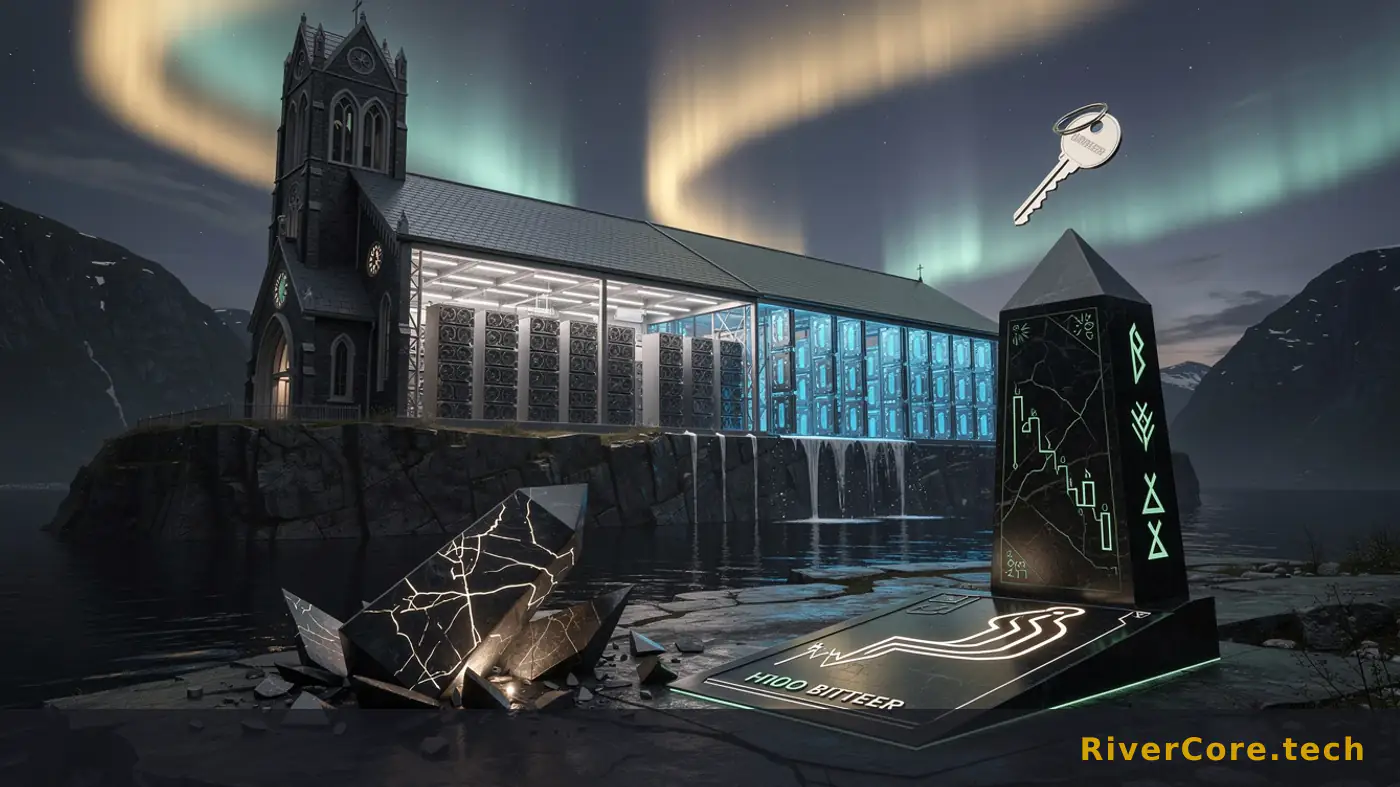
Bitdeer's $4.7B Norway AI Pivot: Miner Becomes Landlord
Bitdeer just signed a $4.7 billion AI data center lease in Norway, and the market couldn't decide whether to cheer or flinch. The stock popped on the announcement, then gave the move back the same session. For a company still classified in most portfolios as a Bitcoin miner, a lease of that size is not a side bet, it is a declaration that the balance sheet is being repositioned around GPUs and Nordic power contracts rather than SHA-256 ASICs.
What Happened
On August 4, 2026, at 10:24 AM EDT, as The Block reported, Bitdeer disclosed a $4.7 billion AI data center lease located in Norway. The immediate equity reaction was a classic pop and drop: buyers stepped in on the headline number, then sellers took the other side once the size and duration implications sank in. The story was filed under Business, not Crypto, which itself is a signal about how the sell side is starting to frame the company.
The source does not disclose the lease term, the counterparty, the megawatt capacity, or whether the $4.7 billion is a gross contractual commitment or a net present value figure. That matters because a 15 year lease at $4.7 billion gross implies a very different annual obligation than a 5 year lease at the same headline. We also do not know the split between colocation revenue, tenant compute revenue, or self-operated AI workloads. The bound is this: at $4.7 billion, even if the entire figure is spread over a decade, the annual run rate commitment is on the order of hundreds of millions of dollars, which is material against any Bitcoin miner's current opex line.
Compare this to the reference frame most investors carry for Bitdeer: a hash-rate operator whose margin swings with Bitcoin price and network difficulty. A $4.7 billion Norwegian AI lease breaks that mental model. The pop reflected the AI narrative premium. The drop reflected the market doing the arithmetic on capex, dilution risk, and execution.
Technical Anatomy
The reason Norway shows up in this story is not scenery, it is the power stack. Nordic grids offer hydroelectric baseload at price points and carbon intensities that hyperscalers increasingly need to hit their reporting commitments. Cold ambient air cuts PUE (power usage effectiveness) meaningfully versus Texas or Arizona sites, which for a dense H100 or B200 class deployment translates directly into more sellable compute per contracted megawatt.
Retrofitting a Bitcoin mining site for AI training or inference is not a firmware update. ASIC halls are built around single-phase, high-density, low-redundancy racks with air cooling designed for machines that tolerate 75C intake and don't care about jitter. GPU training clusters need N+1 or 2N power redundancy, liquid cooling loops or rear-door heat exchangers, low-latency InfiniBand or RoCE fabrics, and structured cabling that a mining shed simply does not have. The economics of a lease at this scale suggest either purpose-built new construction or a deep retrofit, not a repainted ASIC farm.
There is also a workload question the source doesn't answer. AI training tenants want 20 to 100 megawatt contiguous blocks with tight network topology. Inference tenants want geographic distribution and lower per-site density. Sovereign or regulated European tenants want data residency, which Norway (EEA, not EU) offers with nuance. Without knowing the target tenant profile, we cannot judge whether the $4.7 billion is priced against training economics (higher revenue per MW, lumpier demand) or inference economics (steadier, lower ceiling). My working assumption: at this size, Bitdeer is targeting at least one anchor training tenant, because inference alone rarely justifies a decade of Norwegian capex.
For crypto infrastructure teams, the technical read is that the substrate under Bitcoin mining and the substrate under AI compute are converging on the same three constraints: power PPAs, cooling design, and interconnect. The company that wins is the one whose site selection and electrical engineering can pivot workloads without rebuilding the shell.
Who Gets Burned
Pure play Bitcoin miners without an AI story are the first exposed cohort. When one of the larger listed miners commits $4.7 billion to non-mining infrastructure, it raises the cost of capital for peers who are still pitching investors on hash-rate growth alone. Expect the next 90 days to bring either copycat announcements from Marathon, Riot, Hut 8, CleanSpark and Core Scientific style operators, or a widening valuation gap between miners who have pivoted and miners who haven't.
Bitdeer shareholders are the second exposed group, at least in the short term. The pop and drop tells you the market has not underwritten the transition. A $4.7 billion commitment against a mining company's balance sheet almost certainly implies financing: debt, equity, structured leases, or joint venture capital. The source does not tell us which, and that is the single most important unknown for equity holders. If it's equity heavy, dilution hits book value per share immediately. If it's debt heavy, interest coverage becomes the new watch metric. If it's a sale-leaseback or JV, the accounting is cleaner but the upside is capped.
European colocation incumbents (Green Mountain, Bulk, Hyperco, and the hyperscaler-owned Nordic campuses) now have a well-funded new entrant fishing in their tenant pool. Norwegian power authorities and grid operators also inherit a planning problem: absorbing another multi-hundred-megawatt load onto regional substations is not trivial, and permitting timelines in Norway have tightened as public sentiment on data center power draw has hardened.
The cohort that benefits, quietly, is Bitcoin's difficulty curve. Every miner that redirects capex to AI is a miner not deploying incremental hash rate. If this pattern accelerates across the top ten public miners, network difficulty growth should decelerate. That is a testable prediction: if two or more listed miners announce comparable AI pivots by year end 2026, Bitcoin difficulty growth in Q1 2027 should print materially below its trailing four-quarter average.
Playbook for Crypto and DeFi
For crypto treasury and infrastructure teams reading this, a few concrete moves this week.
First, if your protocol depends on stable hash-rate economics (restaking constructions collateralized by mining exposure, structured products referencing miner equities, or lending books with miner counterparties), reprice the assumption that miners will keep reinvesting in ASICs. The revenue mix is bifurcating.
Second, if you are building compute-heavy crypto infrastructure (ZK proving networks, AI-adjacent oracle stacks, decentralized inference marketplaces), Norwegian and broader Nordic capacity just got more contested. Lock power-adjacent colocation contracts now rather than in Q4, because the tenant queue is about to lengthen. Teams building on Solana or other high-throughput chains where validator hardware costs matter should model a 12 to 18 month tightening in premium colocation availability.
Third, watch the disclosure cadence. Bitdeer will need to file supplementary detail on the lease structure. When it does, the two numbers to extract are annual cash commitment and contracted revenue backlog. The ratio between them is the entire investment thesis.
Fourth, for CFOs at crypto-native firms considering their own AI compute buildouts: a $4.7 billion lease is the new anchor comp in the market. Any RFP you run against Nordic providers should reference this scale, because it tells you what tier-one pricing now looks like at volume.
Key Takeaways
- Bitdeer committed $4.7 billion to a Norwegian AI data center lease on August 4, 2026, and the stock popped then dropped the same session.
- The source does not disclose lease term, megawatt capacity, or financing structure, which are the three variables that determine whether this is accretive or dilutive.
- Bitcoin mining and AI compute are converging on the same physical substrate: power PPAs, cooling design, and interconnect. Site portfolios are becoming workload-agnostic.
- Pure-play miners without an AI narrative face a widening cost-of-capital gap. Expect copycat announcements or valuation compression within 90 days.
- Testable prediction: if two or more top-ten listed miners announce comparable AI pivots by end of 2026, Bitcoin network difficulty growth in Q1 2027 should print below its trailing four-quarter average.
Frequently Asked Questions
Q: Why did Bitdeer's stock pop and then drop on the AI data center news?
The pop reflected the AI narrative premium that has repriced compute-adjacent equities since 2024. The drop reflected the market doing arithmetic on a $4.7 billion commitment against a mining company's balance sheet, where financing structure and lease term are undisclosed and materially affect dilution and coverage ratios.
Q: Can a Bitcoin mining facility be converted directly into an AI data center?
Not cleanly. ASIC halls are built around high-density air-cooled racks with minimal redundancy, while GPU training clusters need liquid cooling, N+1 or 2N power, and low-latency interconnect fabrics. A lease of this size implies purpose-built construction or a deep retrofit rather than a repainted mining shed.
Q: What does Bitdeer's pivot mean for the rest of the Bitcoin mining sector?
It raises the cost of capital for miners still pitching pure hash-rate growth. Expect either copycat AI announcements from other top-ten listed miners within 90 days, or a widening valuation gap between operators who have pivoted and those who haven't. Bitcoin network difficulty growth may also decelerate as capex reallocates.

S&P Global Acquires OpenZeppelin to Rate Onchain Risk
S&P Global is buying OpenZeppelin, the smart contract library maintainer behind $37tn in transferred value. Ratings agencies are now underwriting Solidity.

UAE Pass Moves 12.5M Users to Avalanche L1 for Document Vault
UAE's national ID platform, used by 12.5M people across 15,000 services, is moving its Digital Vault onto a dedicated Avalanche L1. Here's what actually matters.

US-UK Stablecoin Roadmap Puts Fed on a Racing Clock
The US and UK just aligned on stablecoin reserves, insolvency priority, and tokenized asset rules, with a $44B UK output claim and a January 2027 GENIUS Act deadline attached.