
Anthropic's Claude Tag Lands in Slack: What Engineers Need to Know
Any platform lead who has integrated an LLM into a production Slack workspace knows the real problem isn't the model. It's the permissions, the audit logs, and the 3am question of who exactly authorised a bot to read the incidents channel. Anthropic shipped Claude Tag on Wednesday with that operational reality baked in, and existing Claude in Slack users have until August 3 before the legacy experience goes dark.
What Happened
On June 24, Anthropic launched Claude Tag, a Slack-native agent that replaces its previous chatbot inside the Salesforce-owned collaboration platform. As The Economic Times reported, the agent runs on Opus 4.8, the model Anthropic released roughly a month earlier in May 2026.
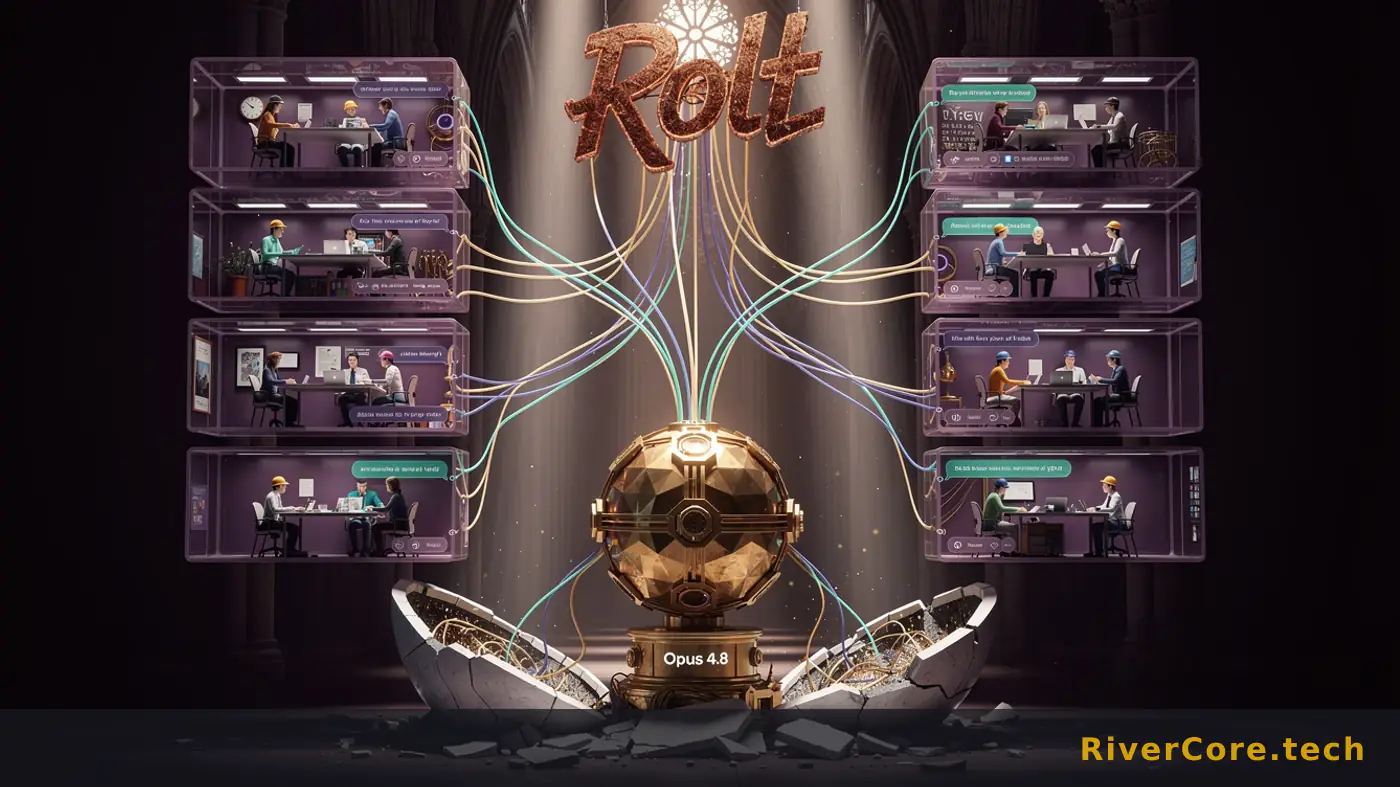
The pitch is straightforward. Users tag @Claude in a channel, DM the agent, or reach it through Slack's AI assistant panel. One Claude Tag instance lives per channel and behaves as a shared teammate, not a private session per user. It pulls from organisation-approved tools and code repositories, holds onto channel and workspace context, and works asynchronously, pinging users only when a task finishes.
Andrej Karpathy, newly joined to Anthropic and now leading the pre-training team, framed it on X as "a new approach for interacting with Claude that is significantly more 'inline' with all the other human activity org-wide." He emphasised the under-the-hood engineering across tools, integrations, compute, memory, and security required to make it "just work."
The internal stat Anthropic is publicising: Claude Tag now contributes to over 65% of product-team code generation inside the company, across engineering, support, analytics, and operations. That's a number worth pausing on. If two thirds of code in a frontier lab is agent-generated, the human role has already shifted to review and orchestration, not authorship. Whether that translates outside Anthropic's own walls is a separate question.
The agent is in beta for Team and Enterprise Slack customers. Existing Claude in Slack users will be migrated automatically, with the cutover on August 3. Anthropic plans to expand Claude Tag beyond Slack over time.
Technical Anatomy
The interesting architecture choice here is the per-channel singleton. One Claude Tag per Slack channel, not per user, not per workspace. That's a deliberate decision with real consequences for how memory and state work.
Memory and permissions are scoped to specific workspaces and channels. That means the agent in #payments-platform cannot bleed context into #hr-confidential, at least by design. Only organisation Owners or Primary Owners can provision Claude Tag's identity, connect tools, define which channels it can enter, set spend limits, and review activity logs. This is a tighter admin model than most off-the-shelf Slack bots ship with, and it suggests Anthropic learned from enterprise security reviews on the previous chatbot.
Opus 4.8 under the hood matters for two reasons. First, the model is recent enough to handle multi-step tool use without falling over, which is the table stakes for any agent that schedules tasks and revisits unfinished work. Second, async execution means the model is running on Anthropic compute, not the user's machine, so latency and cost characteristics are entirely server-side. If you want to understand the agentic patterns powering this, the Anthropic docs on tool use and computer use are the relevant reference.
Compare this to Claude Code, which Anthropic launched in February 2025. Claude Code is terminal-based, single-player, runs on a developer's local machine, and has direct read/write/execute access to the local file system. It's a power tool for one engineer. Claude Tag is the opposite shape: multiplayer, hosted, scoped to an org's Slack tenant, and explicitly designed to be a shared teammate rather than a personal assistant.
The proactive notification model is the part I'd watch carefully. An agent that schedules tasks, revisits unfinished work, and pings users unprompted is an agent that can also generate notification storms. My take: the first production incidents with Claude Tag will be operational noise, not security breaches.
Who Gets Burned
The legacy Claude in Slack switchover on August 3 gives teams roughly six weeks. That's tight for anyone who built workflow automations against the old chatbot's interaction model. If your support team has playbooks that assume the previous behaviour, you have a migration project on your hands, not a passive upgrade.
Three categories of buyer get squeezed here. First, the standalone Slack-AI-integration vendors. If you sell a thin wrapper that pipes Slack messages into an LLM and posts the response back, Claude Tag with native admin controls, audit logs, and per-channel memory has eaten your lunch. The uncomfortable read: a lot of seed-stage AI productivity startups just became features.
Second, internal platform teams at fintech and iGaming operators who built their own Slack bots on top of the Claude or OpenAI APIs. Those bots probably don't have spend limits, channel scoping, or activity logs at the granularity Anthropic just shipped. Your security and compliance teams will start asking why the in-house version is weaker than the off-the-shelf one. Patterns I've seen in similar migrations: the build-vs-buy conversation reopens within a quarter.
Third, anyone running regulated workloads in Slack channels. The per-channel memory and Owner-only provisioning model is genuinely useful for SOC 2 and ISO 27001 audits, but it also means your compliance team needs to inventory which channels the agent is allowed into before the August cutover, not after. If a Claude Tag instance ends up in a channel containing PII or payment data without a documented control, that's an audit finding.
The 65% internal code-generation figure also reframes the hiring conversation. On a 10-engineer team, that's the equivalent productivity ceiling of six and a half engineers worth of code output coming from an agent. Headcount planning conversations get awkward fast.
Playbook for AI Development
Concrete actions for this week if Claude Tag is on your radar:
Run a channel inventory before August 3. List every Slack channel in your workspace, classify them by data sensitivity, and decide explicitly which ones Claude Tag is allowed to join. Owners-only provisioning is useless if your Owners haven't done the homework.
Set spend limits before you enable the agent, not after. Async agents that schedule and revisit tasks can chew through tokens faster than synchronous chatbots. Cap it, then raise the cap based on observed usage.
Audit your existing Slack bots. If you have homegrown integrations that overlap with what Claude Tag does, decide now whether to deprecate them or keep them. Running both in parallel creates ambiguity about which agent owns a task, and that ambiguity is where incidents happen.
Treat the activity logs as a first-class observability surface. Pipe them into your existing logging stack alongside application logs. If you can't query "what did the agent do in #production-deploys last Tuesday" in under a minute, you don't have real auditability.
If you're building agent integrations more broadly, the Model Context Protocol spec is worth reading. The patterns Anthropic is using for tool scoping in Claude Tag mirror the broader direction agent integration is heading.
Finally, do not let the 65% internal stat drive your own targets. Anthropic dogfooding its own model on its own codebase is the best-case scenario. Your codebase is not Anthropic's codebase. Start with measurable pilots in one team before claiming productivity numbers to leadership.
Key Takeaways
- Claude Tag replaces the legacy Claude in Slack chatbot on August 3, 2026. Migration is automatic but workflow assumptions may break.
- One agent per channel, powered by Opus 4.8, with memory and permissions scoped to workspaces and channels.
- Owner-only provisioning, spend limits, and activity logs are stronger than most homegrown Slack bot setups, which reopens build-vs-buy questions.
- Anthropic claims 65% of internal product-team code generation comes from Claude Tag. Treat as aspirational, not a benchmark.
- Currently beta-only for Team and Enterprise Slack customers, with expansion beyond Slack planned.
Frequently Asked Questions
Q: What is the difference between Claude Tag and Claude Code?
Claude Code is a terminal-based, single-player tool that runs on an individual developer's local machine and can read, write, and execute files locally. Claude Tag is a multiplayer, hosted agent that lives inside Slack channels, uses organisation-approved tools, and operates asynchronously as a shared teammate.
Q: When does the old Claude in Slack chatbot stop working?
The legacy Claude in Slack experience switches over to Claude Tag on August 3, 2026. Existing users are migrated automatically, but teams with custom workflows built against the old interaction model should plan migration work before that date.
Q: Who can install and configure Claude Tag in a Slack workspace?
Only Slack organisation Owners or Primary Owners can provision the agent's identity, connect tools, define which channels it can access, set spend limits, and review activity logs. Permissions and memory are scoped per workspace and channel to prevent cross-team data leakage.

LLM Price War Hits Enterprise: Opus 5.5 Cuts 20% Ahead of IPO
Anthropic, Google, and four Chinese labs are shipping foundation models in the same two-week window. The pricing signal matters more than the benchmarks.

Crusoe's $3.9B Series F Redraws the AI Infra Buy List
Crusoe just raised $3.9B at a $30.9B valuation on the back of $140B in contracted value. Here's what that means for anyone signing a multi-year AI compute deal this quarter.

Meta Ads Get Pricier in India as CPMs Climb 15-20%
Meta ad prices in India are up 15-20% year-on-year while the pool of actual online shoppers barely grew. The auction is eating D2C margins.