
Core Scientific Buys Polaris for $421M to Feed Oklahoma AI Campus
Picture a railway company in 1955 buying up branch lines nobody else wanted. Not for the trains. For the right of way. That's roughly what Core Scientific just did to Polaris, and the freight on these tracks isn't coal or grain, it's GPU clusters humming away in Oklahoma.
On the morning of May 6, 2026, at 10:13AM EDT, Core Scientific announced it's acquiring bitcoin miner Polaris in a $421 million deal aimed at expanding its AI data center campus in Oklahoma. The headline says "miner buys miner." The reality, as anyone who has stared at a one-line diagram of a 200MW substation knows, is that this is a real estate and power play wearing a crypto jersey.
What Happened
The bones of the transaction are simple enough. Core Scientific is acquiring Polaris, described as a bitcoin miner, in a Mergers and Acquisitions transaction valued at $421 million, as The Block reported on the morning of the announcement. The stated purpose isn't to grow Bitcoin hashrate. It's to expand an AI data center campus in Oklahoma.
That sentence deserves a second read. A bitcoin miner is paying nine figures for another bitcoin miner with the explicit intention of converting the asset, or at least the underlying infrastructure, into AI compute capacity. The mining sector has been quietly doing this dance since the last halving, but $421 million is not a tip-toe. It's a stride.
The deal slots neatly into a pattern that's been building across the publicly traded miner cohort: balance sheets fattened by the 2024 to 2025 BTC run, a halving that squeezed coin-denominated margins, and an HPC market screaming for any building with a fence around it and a fat power feed. Polaris becomes the latest branch line absorbed into a larger network. The question every CTO and platform lead in crypto should be asking is whether Polaris is the exception or the template.
My read: it's the template. The miners that survive the next two years won't be the ones with the cheapest joules per terahash. They'll be the ones whose substations can be repointed at an Nvidia rack without ripping up the slab.
Technical Anatomy
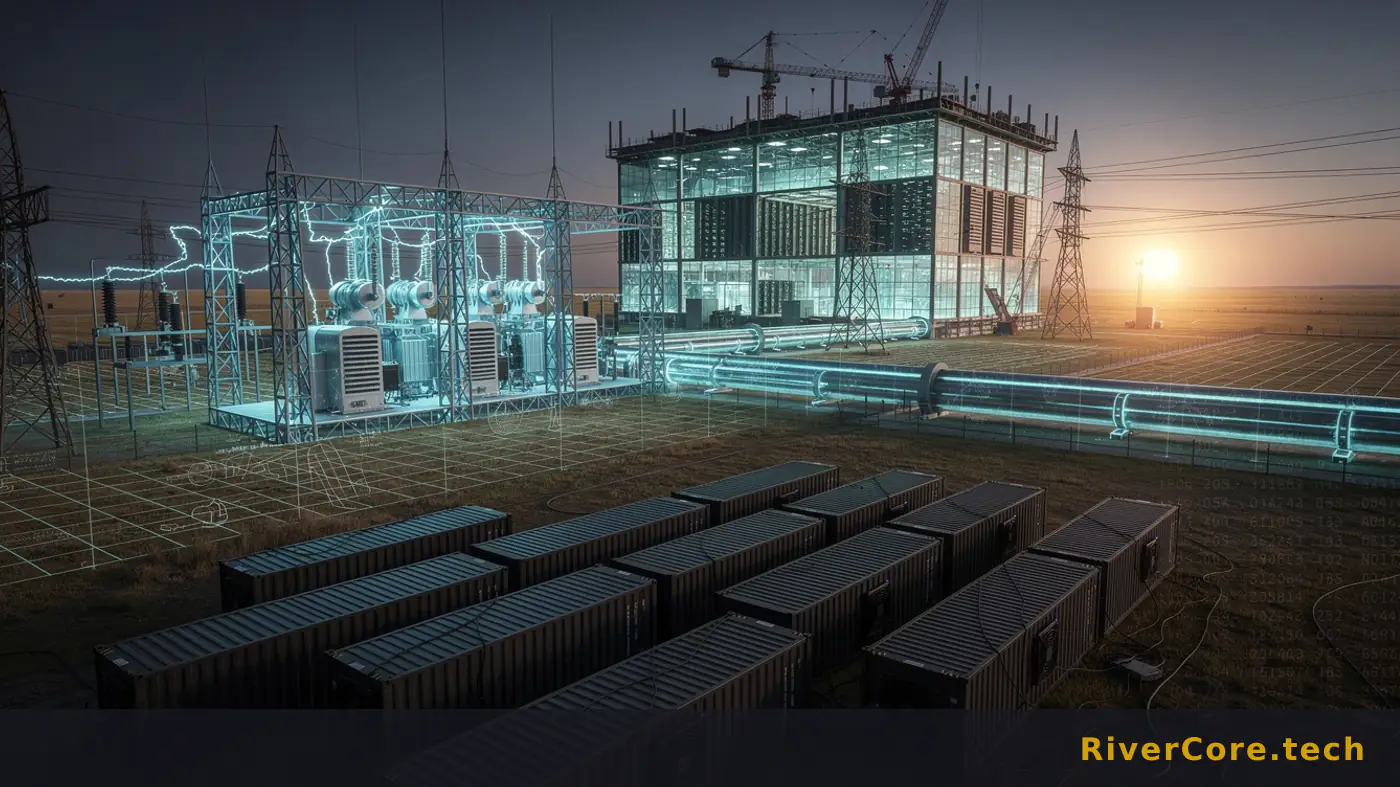
The boring bit, which is also the bit that matters, is the physical plant. A bitcoin mining site and an AI training site share roughly 60% of their DNA: high-voltage interconnect, transformer yards, cooling, fiber, fenced perimeter, environmental permits. They diverge sharply on the other 40%.
Bitcoin ASICs tolerate filthy power and brutal thermal envelopes. They're effectively immersion-friendly toasters that don't care if a phase wobbles. AI training clusters, particularly anything running synchronous gradient descent across thousands of accelerators, are the opposite animal. They demand clean, redundant power, ultra-low-latency east-west networking, liquid cooling at densities of 50 to 130kW per rack, and the kind of uptime SLAs that make a mining engineer laugh into his coffee.
So when Core Scientific says it's expanding an AI campus by acquiring a miner, the engineering translation is: we're buying interconnect rights, energized substations, and a permitted shell, then ripping out the ASICs and rebuilding the inside. The hashrate is essentially salvage value. The grid connection is the actual product.
Oklahoma matters here too. The state sits on cheap natural gas, has a relatively permissive utility regime, and access to ERCOT-adjacent and SPP power markets that let operators arbitrage curtailment. For an HPC tenant, that translates to PPAs that pencil out at a fraction of Northern Virginia or Santa Clara rates, which is why hyperscalers have been quietly scouting the region for two years.
The part where it all falls over, for the miner-turned-AI-landlord, is networking. Building a Tier III equivalent fabric on top of a site originally specced for Bitmain S21s is not a rebrand. It's a gut renovation. Anyone who has tried to retrofit InfiniBand into a building that was designed for forced-air ASIC sheds knows the cable trays alone will eat your timeline.
Who Gets Burned
The first cohort feeling the heat is the mid-tier public miner that doesn't have a pivot story. If Core Scientific is paying $421 million for Polaris specifically because of its Oklahoma footprint, every miner without a comparable land-and-power thesis just got reranked by the market as a pure-play hashrate bet, which is to say, a used BTC ETF with worse fees.
The second cohort is the smaller HPC colocation operator. The mining-to-AI conversion crowd is showing up to the auction with mining-era cost bases on land and substations, then layering AI-era revenue assumptions on top. That's a hard arithmetic to compete with if you bought your facility at a 2024 enterprise data center multiple.
The third, and most uncomfortable, cohort is Bitcoin itself. Hashrate that gets repurposed to AI doesn't come back. Every megawatt converted from SHA-256 to H100s is a permanent reduction in the network's industrial footprint in North America. The hashrate will redistribute, probably to operators with stranded gas or to jurisdictions with looser rules, but the geographic concentration of the network shifts. For protocol-level folks, that's a security model conversation worth having out loud.
For DeFi teams and crypto-adjacent fintechs, the second-order effect is liquidity. Public miners have been a meaningful source of BTC sell pressure into spot markets. If their treasuries shift toward HPC revenue and away from coin-denominated income, the structural flow into exchanges thins. Anyone who has run a market-making book on a CEX through a halving cycle knows what a change in miner flow does to depth.
Playbook for Crypto and DeFi
If you're a CTO or platform lead in this space, three concrete moves are worth putting on the agenda this quarter.
First, audit your miner exposure. If you run a lending protocol, a miner-collateralized credit desk, or a structured product referencing hashrate, your underlying assumption that "this counterparty is a Bitcoin business" is increasingly wrong. The collateral is becoming a hybrid HPC and BTC operator. Update your risk models. Reprice the basis.
Second, look hard at the infrastructure stack you're paying for. If you're running validator clusters, MEV infrastructure, or zk-prover farms, the same Oklahoma-shaped sites being scooped up for AI are direct comps for your colocation costs. Lock multi-year power-inclusive contracts now, before the AI bid eats the supply. The miners pivoting upmarket aren't going to want crypto infra tenants at last year's rates.
Third, watch the regulatory wash. The SEC's posture toward miners as securities issuers has historically hinged on the BTC-centric business model. A miner that derives the majority of revenue from AI colocation is a different regulated animal, and the disclosures will follow. If you're an investor or a counterparty, the 10-K you read in 2024 isn't the company you're dealing with in 2027.
The opportunistic angle: if you're a DePIN or decentralized compute project, the Polaris deal is your pitch deck. Centralized AI infra is consolidating into nine-figure transactions. The case for permissionless alternatives just got a fresh data point.
Key Takeaways
- Core Scientific's $421 million acquisition of Polaris, announced May 6, 2026, is being framed as an AI data center expansion in Oklahoma, not a hashrate play.
- The real asset being purchased is energized substation capacity and permitted land, not the ASIC fleet, which is effectively salvage in the AI conversion math.
- Mid-tier public miners without a credible HPC pivot are being repriced as pure-play BTC bets, which compresses their valuation multiple.
- Bitcoin loses industrial footprint in North America every time a site converts to AI, with knock-on implications for hashrate geography and security assumptions.
- DeFi protocols, lending desks, and crypto infrastructure tenants should reprice miner counterparty risk and lock colocation contracts before the AI bid eats remaining capacity.
Back to the railway analogy. The branch lines weren't valuable for what ran on them in 1955, they were valuable for the corridor itself, which is why Amazon eventually ran fiber down half of them. Core Scientific just bought a corridor. Whether it ends up carrying GPUs, ASICs, or something we haven't named yet, the operators who own the right of way write the rules. The rest of us pay the toll.
Frequently Asked Questions
Q: Why is a bitcoin miner buying another bitcoin miner to build AI infrastructure?
The acquisition target's value lies in its physical infrastructure, energized substations, permitted land, grid interconnect, rather than its mining hardware. Converting these sites to AI data centers is faster and cheaper than building new ones from scratch, especially in power-rich states like Oklahoma.
Q: What does the Core Scientific and Polaris deal mean for Bitcoin's hashrate?
Every megawatt converted from SHA-256 mining to AI compute is a permanent reduction in that site's contribution to Bitcoin's network. The hashrate redistributes globally, often toward jurisdictions with looser regulation or stranded energy, which shifts the geographic concentration of network security.
Q: Should DeFi protocols care about miner-to-AI conversions?
Yes. Public miners have historically been a steady source of BTC sell pressure on exchanges, and lending protocols often hold miner-related collateral. As miners shift revenue toward AI colocation, the assumptions baked into liquidity models, collateral risk frameworks, and basis trades all need updating.

Treasury Sanctions BitBank as Iran's Bitcoin Pipeline Grows
OFAC designated Iranian exchange BitBank under Operation Economic Outcast, targeting a bitcoin laundering pipeline active since June. The technical problem: BTC can't be frozen.
S&P Global Acquires OpenZeppelin to Rate Onchain Risk
S&P Global is buying OpenZeppelin, the smart contract library maintainer behind $37tn in transferred value. Ratings agencies are now underwriting Solidity.

UAE Pass Moves 12.5M Users to Avalanche L1 for Document Vault
UAE's national ID platform, used by 12.5M people across 15,000 services, is moving its Digital Vault onto a dedicated Avalanche L1. Here's what actually matters.