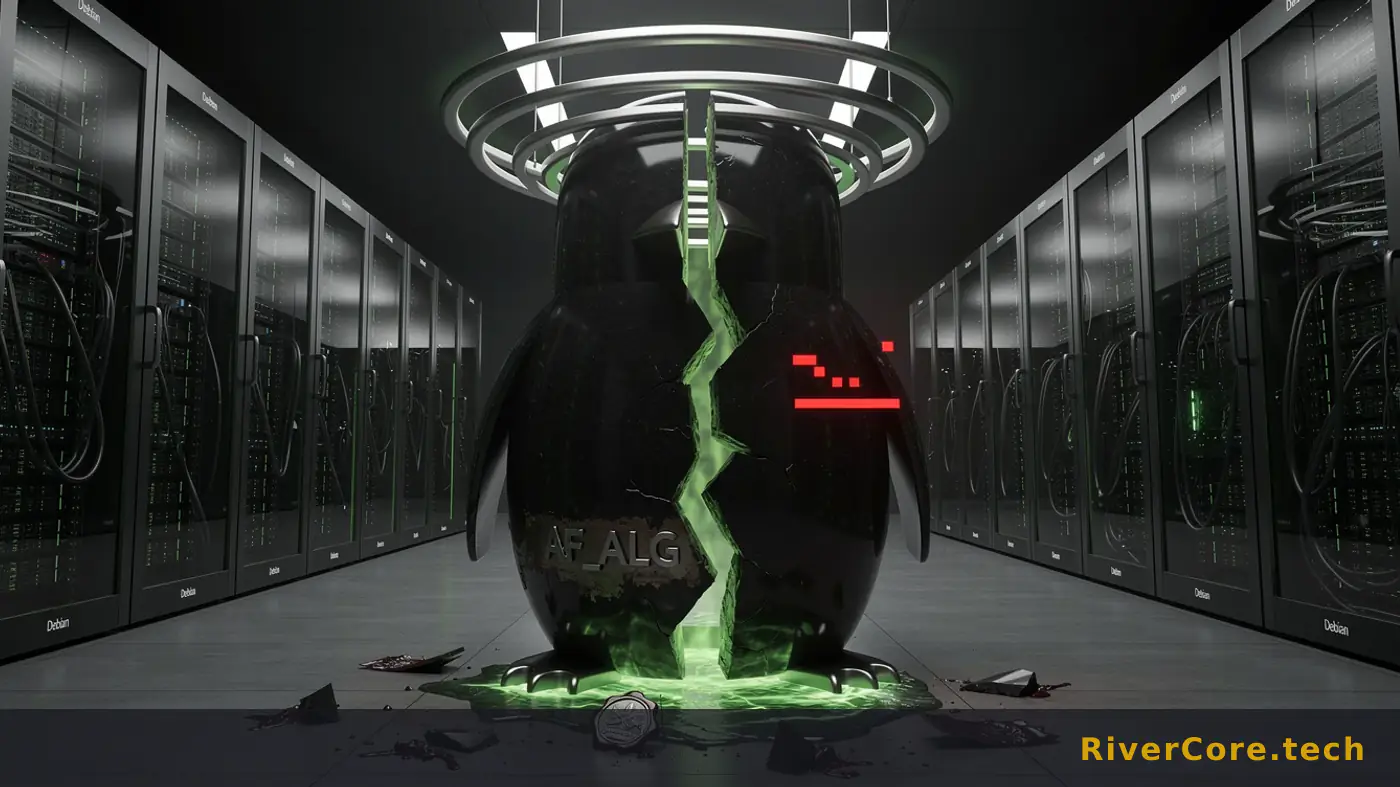
Dirty Frag Zero-Day Hands Root on Every Major Linux Distro
Picture a bridge that's been carrying traffic safely for nearly a decade, and one Thursday morning a structural engineer publishes the precise load and angle that collapses it. That's the position Linux fleet operators woke up to on May 8th. A researcher named Hyunwoo Kim disclosed Dirty Frag, a local privilege escalation that turns any unprivileged user into root on essentially every distribution that matters, and the embargo had already been kicked out from under him the day before.
The bridge analogy is going to do some work in this piece, because Dirty Frag isn't a single cracked girder. It's two flaws in the deck, chained, and the kernel has been carrying that load since around 2017.
What Happened
On May 8, 2026 at 03:45 AM, security researcher Hyunwoo Kim published full documentation and a working proof-of-concept for Dirty Frag, a local root exploit that works with a single command on most major Linux distributions. As BleepingComputer reported, the bug was introduced roughly nine years ago in the kernel's algif_aead cryptographic algorithm interface and has been quietly waiting in mainline ever since.
Kim didn't want to drop it like this. He had coordinated with distro maintainers through [email protected], the standard pre-disclosure list for exactly this kind of cross-vendor coordination. Then on May 7th, an unrelated third party independently published the exploit, and the embargo went up in smoke.
"Because the embargo has currently been broken, no patch or CVE exists," Kim wrote. "After consultation with the maintainers on [email protected] and at their request, this Dirty Frag document is being published." Translation: once the cat was out, withholding the technical writeup only hurt defenders.
By 09:58 EDT the same day, the two underlying flaws had been wrapped into CVE entries: CVE-2026-43284 for the xfrm-ESP Page-Cache Write vulnerability, and CVE-2026-43500 for the RxRPC Page-Cache Write vulnerability. The affected list reads like a roll-call of production Linux: Ubuntu, Red Hat Enterprise Linux, CentOS Stream, AlmaLinux, openSUSE Tumbleweed, and Fedora. None of them had patches at publication time.
And it lands while everyone's still mid-rollout on Copy Fail, the previous root escalation now under active exploitation.
Technical Anatomy
Dirty Frag belongs to the same bug class as Dirty Pipe and Copy Fail, but it bites a different girder of the bridge. Where Dirty Pipe abused the splice/pipe page-cache plumbing, Dirty Frag goes after the fragment field of a separate kernel data structure exposed through algif_aead, the userspace-facing crypto interface for authenticated encryption.
The exploit chains two distinct page-cache write primitives. The first is the xfrm-ESP Page-Cache Write bug (CVE-2026-43284), reachable through the IPsec ESP transform code. The second is the RxRPC Page-Cache Write bug (CVE-2026-43500), reachable through the AFS-style RPC stack. Each on its own is a memory-corruption foothold. Chained, they let an unprivileged process modify protected system files in the page cache without going through the file permission checks the VFS layer is supposed to enforce. Which means: rewrite a SUID binary, or /etc/passwd, or any other privileged on-disk file that's currently cached, and you're root.
Here's the part that should make every kernel-curious engineer sit up. Kim describes Dirty Frag as "a deterministic logic bug that does not depend on a timing window, no race condition is required, the kernel does not panic when the exploit fails, and the success rate is very high." That's the engineering nightmare scenario. Race-condition exploits are flaky, noisy, and often crash the host on failure, which gives EDR something to scream about. A deterministic logic bug is the opposite: quiet, repeatable, scriptable, and stuffable into the post-exploitation stage of any commodity malware kit.
Anyone who has shipped kernel modules to a production fleet knows the boring bit: the most dangerous bugs aren't memory-safety theatre, they're logic flaws in interfaces nobody audits because they look like glue code. algif_aead is exactly that kind of glue. It's been sitting on the bridge for nine years because it does its job and nobody had reason to look hard at the fragment-handling path.
Who Gets Burned
The blunt answer: anyone running multi-tenant Linux. The sharper answer depends on who your unprivileged users are.
Shared hosting, CI runners, Kubernetes nodes with untrusted workloads, university clusters, bug bounty sandboxes, and any iGaming or fintech platform that lets customer-controlled code execute on shared hosts: these are the deck of the bridge. A local privilege escalation matters far more when "local" includes a tenant. For Kubernetes operators specifically, a container escape plus Dirty Frag equals full node takeover, and from there the kubelet credentials and secrets mounted on that node are gone.
Payments and trading shops with strict change-control windows are in an awkward spot. Kernel patching means reboots, reboots mean maintenance windows, maintenance windows in regulated environments mean approvals. The mitigation Kim provides, removing the esp4, esp6, and rxrpc kernel modules, is a real fix but it's not free. It breaks IPsec VPNs and AFS distributed file systems. If your site-to-site connectivity rides on IPsec, ripping out ESP isn't a one-liner, it's an architecture change.
Federal agencies still chasing the Copy Fail deadline are in the worst position of all. CISA added Copy Fail to its Known Exploited Vulnerabilities Catalog the previous Friday, with a May 15 deadline to secure federal Linux devices. CISA's standing line on this class of bug, that it "is a frequent attack vector for malicious cyber actors and poses significant risks to the federal enterprise," now applies to two simultaneous unpatched root holes. And Pack2TheRoot, patched in April after a decade in the PackageKit daemon, makes three in roughly thirty days.
The pattern is what should worry CTOs. Old code, deep in the stack, found by individual researchers, dropping faster than enterprise patch cadences can absorb.
Playbook for Security Teams
This week, not next sprint:
First, decide whether you can drop the modules. Run lsmod | grep -E 'esp4|esp6|rxrpc' across your fleet. If the answer is "loaded but unused," apply Kim's mitigation: blacklist them in /etc/modprobe.d/ and rmmod the live ones. If you're using IPsec or AFS, you can't, and you need a compensating control instead.
Second, lock down who can reach algif_aead. The interface is gated by AF_ALG sockets. seccomp profiles that deny socket(AF_ALG, ...) for untrusted workloads kill the attack surface for that process tree. For container platforms, this is a Pod Security policy or gVisor/Kata change. Do the audit now while everyone's paying attention.
Third, treat your CI runners and ephemeral compute as compromised-by-default until the patch lands. Rotate any long-lived credentials those hosts can reach. Anyone who has cleaned up after a runner takeover knows the cleanup bill is bigger than the patch bill by an order of magnitude.
Fourth, watch your detection. Dirty Frag is deterministic and quiet, so the usual "kernel panic spike" signal isn't going to save you. Look for unexpected AF_ALG socket creation by non-crypto workloads, anomalous SUID binary modifications, and page-cache anomalies if your eBPF tooling supports it. Map the behaviour to MITRE ATT&CK T1068 and write the detection before the exploit gets bundled into a botnet, not after.
Fifth, get your kernel patch cadence tested. When upstream lands the fix, you want to be the team that ships in 48 hours, not the one filing a change ticket.
Key Takeaways
- Dirty Frag is a deterministic, single-command local root exploit affecting Ubuntu, RHEL, CentOS Stream, AlmaLinux, openSUSE Tumbleweed, and Fedora, with no patches at disclosure.
- It chains CVE-2026-43284 (xfrm-ESP) and CVE-2026-43500 (RxRPC) through the nine-year-old
algif_aeadinterface, no race condition required. - The embargo broke on May 7 when an unrelated third party published the exploit, forcing Kim to release full documentation a day later.
- Mitigation by removing
esp4,esp6, andrxrpcmodules works but breaks IPsec VPNs and AFS, so it isn't free for production networks. - Coming on top of Copy Fail (already in CISA KEV with a May 15 federal deadline) and April's Pack2TheRoot, this is the third deep-stack Linux root bug in roughly thirty days.
Back to the bridge. Nine years of traffic, two cracked girders, and the engineer who found the failure mode got shoved off the podium mid-presentation. The deck is still carrying load. Whether it carries yours through the next two weeks depends on what you do before Friday.
Frequently Asked Questions
Q: What is Dirty Frag and why is it dangerous?
Dirty Frag is a Linux local privilege escalation exploit disclosed on May 8, 2026 by researcher Hyunwoo Kim. It chains two kernel page-cache write flaws to grant root with a single command on most major distributions, and Kim describes it as a deterministic logic bug with a very high success rate, meaning no race condition and no kernel panic on failure.
Q: Which Linux distributions are affected and is there a patch?
Ubuntu, Red Hat Enterprise Linux, CentOS Stream, AlmaLinux, openSUSE Tumbleweed, and Fedora are all listed as affected. At the time of original publication no patch existed and no CVE had been issued, though the two underlying flaws were later assigned CVE-2026-43284 and CVE-2026-43500.
Q: How can I mitigate Dirty Frag right now?
Kim's recommended mitigation is to blacklist and remove the esp4, esp6, and rxrpc kernel modules. This closes the attack path but breaks IPsec VPNs and AFS distributed file systems, so anyone relying on those needs a compensating control such as seccomp policies blocking AF_ALG sockets for untrusted workloads.