

DTCC Picks Stellar for Tokenized Securities Rails by 2027
Anyone who has ever waited two business days for a securities trade to settle while collateral sat frozen knows why tokenization keeps getting another budget cycle. On Wednesday, the institution that sits at the center of that settlement mess told the market it picked its next chain. DTCC, the clearinghouse routing more than $114 trillion in assets, said it will connect its tokenized securities platform to Stellar by the first half of 2027.
What Happened
DTCC and the Stellar Development Foundation issued a joint announcement on May 27, 2026, confirming that tokenized assets custodied by DTCC's Depository Trust Company could become available on the Stellar network during the first half of 2027. According to CoinDesk, the integration covers issuance, settlement, and lifecycle management of blockchain-based versions of traditional securities. The two organizations also said they plan to explore tokenizing "highly liquid assets" such as major indices and U.S. Treasury debt instruments.
The market read it as a Stellar win. XLM jumped 3% on the news before paring some gains, and was up 1.7% over 24 hours while bitcoin and the broader market pulled back. Outperformance on a red day is the kind of signal allocators notice.
The context matters. DTCC said earlier in May that it plans limited production trades of tokenized assets in July, with a wider rollout in October. That schedule sits on top of an SEC no-action letter granted in December 2025 covering a defined asset set: Russell 1000 stocks, ETFs, and U.S. Treasuries. Frank La Salla, DTCC's President and CEO, framed Stellar as "another step forward" in building "open, interoperable digital infrastructure that bridges traditional and digital markets." Nadine Chakar, DTCC's global head of digital assets, was more explicit about the architecture, saying DTCC plans to connect to "multiple layer-1 and layer-2 networks." Stellar is not the destination. It's a port.
Technical Anatomy
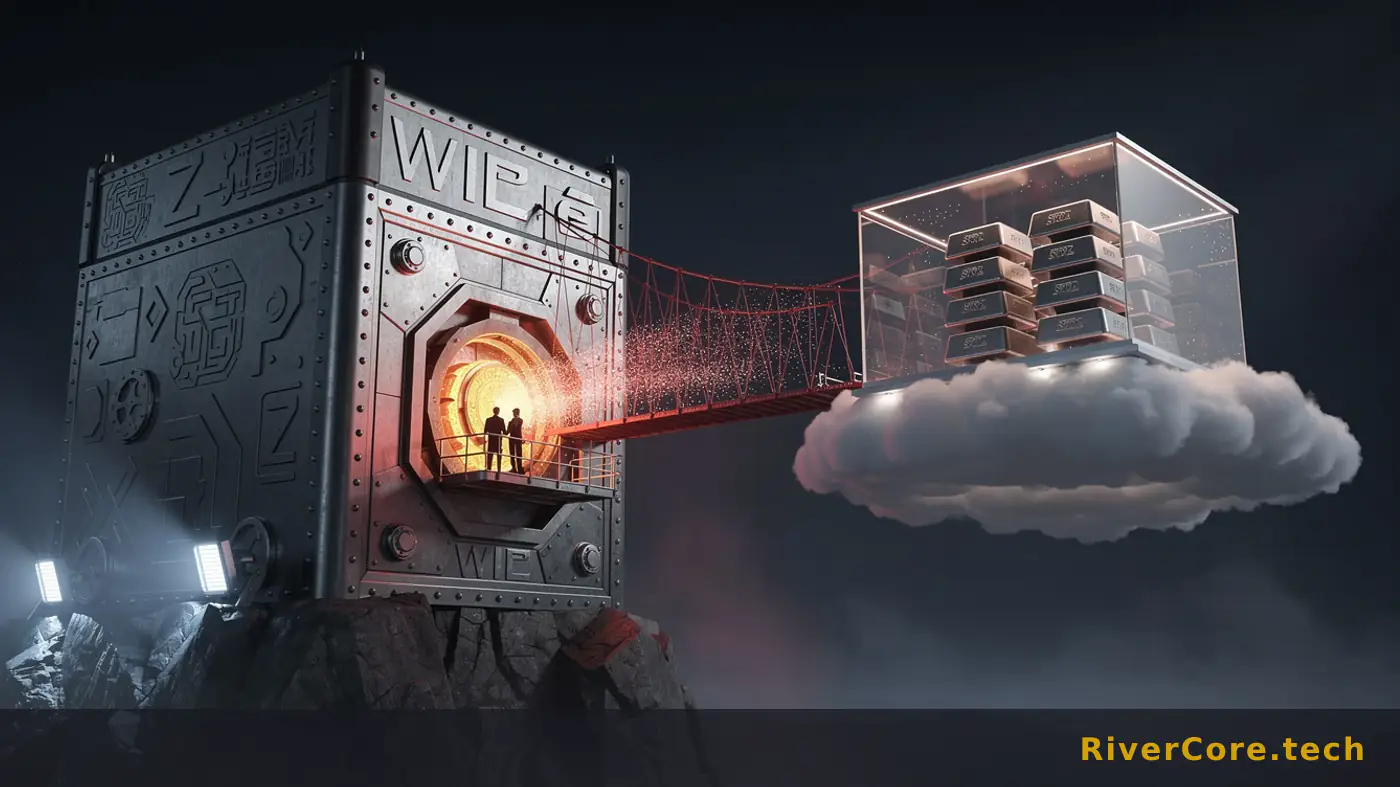
The interesting word in the press release is "multi-chain." DTCC is not migrating to Stellar. It's building a custody and issuance layer that can publish the same security onto whichever chain a counterparty wants to settle on. Stellar gets to be one of the early plugs. That tells you something about the engineering criteria, because Stellar is not the obvious pick for anyone optimizing on developer mindshare or EVM compatibility.
Stellar's selling points line up with clearinghouse priorities, not DeFi composability. It has a permissioned asset issuance model where the issuer controls authorization flags on holders. It has deterministic finality measured in seconds. It does not have a sprawling MEV economy or a memepool full of arbitrary contract calls. For a regulated custodian publishing Russell 1000 representations, those properties read as features. The same properties would frustrate a DeFi protocol team trying to build a used Treasury vault on top.
The harder engineering problem is the bridge between DTCC's internal record of truth and any external chain. Tokenized securities only work if the on-chain representation is legally and operationally pinned to the off-chain custody record. That means reconciliation jobs running on every block, corporate action handlers (splits, dividends, voting) that fire identically on chain and in the legacy ledger, and a kill switch when they drift. DTCC has publicly said it wants "high-performance" chains for tokenizing corporate actions, which is the part of securities lifecycle management that breaks first under volume.
My take: the multi-chain framing is also a hedge against picking a loser. If you remember 2021, every major bank had a Quorum or Corda pilot that quietly died. DTCC has learned the lesson. Build the issuance layer once, expose adapters, let counterparty demand decide which chains get liquidity. Stellar gets early integration. Ethereum L2s and Solana almost certainly follow, because Chakar said the quiet part out loud about layer-1 and layer-2 connectivity. For teams building cross-chain settlement, the CCIP model of message-passing between heterogeneous environments is the closer analog than any single-chain bet.
Who Gets Burned
Start with the obvious losers: any tokenization startup whose pitch deck was "we are the rails for institutional securities." DTCC just told the market that the rails are DTCC, and the chains are commodities underneath. Three years of seed-stage companies promising to be the on-chain DTCC now have to explain what they do when the actual DTCC ships in October.
Next, exchanges with single-chain strategies. Nasdaq is building blockchain-based shares infrastructure with Payward, Kraken's parent. ICE, which owns NYSE, is backing tokenized securities efforts tied to OKX. Both are credible, both will work, but if DTCC settles the Russell 1000 across multiple chains starting October, the exchange-led venues need to articulate why their walled garden is worth the fragmentation. The uncomfortable read: TradFi infrastructure incumbents are moving faster than the crypto-native venues that spent five years lobbying for this exact moment.
DeFi protocols holding tokenized Treasuries face a more subtle squeeze. Today's RWA market is dominated by issuers who wrap T-bills with their own custody story. When DTCC-custodied Treasury tokens land on a public chain in 2027, the trust premium collapses. Production incidents I've seen in similar credit-quality races end the same way: the lower-quality wrapper trades at a discount, then loses redemption velocity, then unwinds messily. Anyone holding non-DTCC Treasury tokens as collateral should be modeling that scenario now, not in Q4 2026.
Finally, Stellar itself is on the clock. The H1 2027 date is generous by enterprise standards and tight by crypto standards. If Stellar ships clean integration, validator throughput holds, and the corporate actions pipeline does not embarrass anyone, XLM gets a structural narrative. If it stumbles, DTCC moves the same workload to the next chain in the queue and the market remembers.
Playbook for Crypto and DeFi
For protocol teams, three things this week. First, audit any RWA exposure for issuer concentration. If your vault depends on a single tokenized Treasury issuer, write down what happens to TVL when a DTCC-issued equivalent goes live. That is not a 2027 problem, that is a positioning problem you solve now.
Second, instrument for multi-chain settlement assumptions. If you are building anything that touches tokenized equities or Treasuries, the working assumption should be that the same ISIN exists on Stellar, an Ethereum L2, and probably Solana by 2028. Your oracles, your liquidation logic, and your collateral factors need to handle the same underlying showing up with different on-chain representations. Pricing one and ignoring the others is how protocols get arbitraged into insolvency.
Third, read the SEC no-action letter scope carefully. It covers Russell 1000 stocks, ETFs, and U.S. Treasuries. It does not cover small caps, structured products, or international securities. The first wave is narrow on purpose. Building products that assume the full equity universe is tokenizable by 2027 is a bet against how regulators actually expand permissions.
For founders, the strategic question is sharper. DTCC controlling $114 trillion in custody is roughly the GDP of the planet flowing through one institution's ledger. Picking a fight with that ledger is unwise. Picking a niche it will not serve, illiquid private credit, exotic derivatives, cross-border retail, is where the next defensible companies get built. Boring is winning at the top of the stack. Build where boring cannot reach.
Key Takeaways
- DTCC will connect its tokenized securities platform to Stellar in H1 2027, with limited production trades starting July 2026 and wider rollout in October.
- The SEC no-action letter from December 2025 limits the initial scope to Russell 1000 stocks, ETFs, and U.S. Treasuries. Plan around that boundary, not the full equity universe.
- "Multi-chain" is the strategy. Stellar is the first plug, not the destination. Ethereum L2s and other layer-1s are next.
- RWA protocols relying on non-DTCC Treasury wrappers should stress-test their thesis against DTCC-custodied equivalents landing on public chains.
- $114 trillion in custody is now actively moving toward blockchain rails. Crypto-native venues like Nasdaq/Payward and ICE/OKX need a differentiator beyond "we got there first."
Frequently Asked Questions
Q: Why did DTCC pick Stellar instead of Ethereum or Solana?
DTCC has not picked Stellar exclusively. It described a multi-chain strategy and said it plans to connect to multiple layer-1 and layer-2 networks. Stellar fits the early use case because its permissioned issuance model and deterministic finality align with regulated custody requirements, but Ethereum and Solana integrations are the obvious next steps.
Q: When can institutions actually trade tokenized securities through DTCC?
DTCC plans to begin limited production trades of tokenized assets in July 2026, with a wider rollout in October 2026. The Stellar-specific integration is targeted for the first half of 2027. The SEC no-action letter granted in December 2025 covers Russell 1000 stocks, ETFs, and U.S. Treasuries.
Q: What does this mean for existing tokenized Treasury products?
Existing RWA issuers face a credit-quality compression once DTCC-custodied Treasury tokens reach public chains. Protocols using non-DTCC Treasury wrappers as collateral should model scenarios where their tokens trade at a discount or lose redemption velocity, and diversify issuer exposure before 2027.

SEC Crypto FAQ Tackles Buybacks, Upgrades, Profit Promises
The SEC quietly dropped a crypto FAQ covering token buybacks, network upgrades, and profit promises. Small document, big consequences for token designers.

Solana Outearns Ethereum on Fees, Loses on Burns
Solana pulled in $23.58M in fees to Ethereum's $12.04M over 30 days, yet Ethereum still burned more tokens. The plumbing tells you why the flip is harder than it looks.
IBM Bets Banks Won't Trust the Cloud With Tokenized Deposits
IBM plugged Digital Asset Haven into Swift's new shared ledger and shipped an on-prem version on IBM Z. The build-vs-buy math for bank digital asset stacks just shifted.