

Gemini's Collapse Is GCP's Windfall: What Platform Leads Do Now
The question every platform lead betting on Gemini as a primary model provider should be asking their CFO this week is whether the contract they're about to sign is with a frontier lab or with a landlord. On August 5th, Google gutted the leadership of the team that produced Gemini 3 Pro. Two days later, the analyst read on GCP's growth curve made the strategic picture clear: DeepMind is done as a top-tier lab, and Google Cloud is the entity that quietly won the internal war for compute.
What Happened
Google announced a complete overhaul of DeepMind leadership. Demis Hassabis, the co-founder and former CEO, is out of day-to-day operations. Jeff Dean, former Chief Scientist and Gemini co-lead, is leaving to co-found a neolab called Discovery Loop. Dean is the person who co-founded Google Brain and started the TPU program, which makes his departure less a resignation and more an institutional signal flare.
He isn't going alone. Sanjay Ghemawat and Quoc Le, both Google Fellows (a title reserved for roughly the top dozen technical contributors in the entire company), are joining him. So is Oriol Vinyals, another Gemini co-lead. That leaves Koray Kavukcuoglu, formerly DeepMind CTO and the last remaining Gemini co-lead, stepping into Hassabis's role.
As SemiAnalysis reported, this exodus follows earlier departures from Noam Shazeer and John Jumper, plus most of the strongest RL researchers on the Gemini team. The context matters: in November 2025, Gemini 3 Pro was arguably the best model in the world and forced Sam Altman to declare a "code red" at OpenAI. Nine months later, Gemini 3.5 Flash flopped, Gemini 3.5 Pro was silently cancelled, and the bridge release, Gemini 3.6 Flash, is generally worse than Muse Spark 1.2, Grok 4.5, and tier 1 Chinese open-source models. Depending on how you count, Gemini sits in 8th or 9th place. Meanwhile, GCP's year-over-year revenue growth is above 100%, driven in large part by TPU allocations to Anthropic and Meta.
Technical Anatomy
The mechanism of Gemini's decline is a compute allocation story, not a research story. Compute is the lifeblood of frontier training runs, and every AGI-pilled lab is racing to lock in gigawatts of capacity years in advance. Google had that capacity in-house. It chose to rent it out.
More than 20% of total TPU shipments from Q3 2026 through Q4 2027 are being sold directly to Anthropic. That figure excludes the hundreds of thousands of TPUs GCP already rents to Anthropic today, plus many hundreds of thousands more committed to Anthropic and Meta over the next six quarters. Thomas Kurian, CEO of Google Cloud, has publicly framed this as TPUs becoming "general purpose infrastructure," citing Citadel and the Department of Energy as customers, and describing Google as a "platform company" when asked why it sells compute to Gemini's fiercest competitors.
The numeric decay on the model side tells the same story from the other direction. Gemini first-party API token growth was 60% in Q1 2026, moving from 10 billion to 16 billion tokens per minute. In Q2 2026 that dropped to 38% growth, reaching 22 billion tokens per minute. Still growing, but decelerating hard. The Gemini Enterprise Agent Platform (formerly Vertex) looks healthier only because it serves third-party models like Claude. That's the tell: enterprise customers on Google's platform are increasingly using someone else's brain.
The talent flywheel then closes the loop. Discovery Loop follows the neolab playbook that David Silver established at Ineffable Intelligence in November of the prior year: top researchers leave Google, raise billions from outside investors and Google Ventures, then spend that capital renting Nvidia GPUs inside GCP. Google monetizes the departure twice, once as an LP through GV, once as a landlord. DeepMind loses coming and going.
Who Gets Burned
Start with any product team that made Gemini its primary inference dependency in the last twelve months. If your roadmap for Q4 2026 assumed Gemini 4 Pro would keep pace with GPT 5.6, Claude, or a "Doug"-class OpenAI model, that assumption is now speculative at best. Industry chatter puts the cancelled Gemini 3.5 Pro at roughly Opus 4.5 level, which is behind GLM 5.2, Fable 5, and GPT 5.6. Betting Q4 revenue on Gemini 4 reversing that gap is a coin flip with someone else's money.
Next, hiring managers at any team that hoped to poach mid-tier DeepMind talent as it dispersed. The top of the stack is already spoken for by Discovery Loop and its neolab peers, funded by tier 1 VCs and Google Ventures itself. What hits the open market will be second-tier, and the price will still be brutal because every well-funded lab is bidding.
Then there's the GC and compliance angle at regulated shops in fintech and iGaming that built vendor risk assessments around a specific Gemini SLA and model-behavior profile. Model deprecation cadence just accelerated. If your KYC narrative-generation pipeline, fraud triage agent, or player-communication summarizer is pinned to a Gemini checkpoint that gets sunset when Gemini 4 ships, you now have a re-certification project you didn't budget for.
The CFO at any Series B fintech burning $200K to $600K per month on Gemini inference should be asking their VP Eng this week whether the abstraction layer between application code and model provider is real or aspirational. If switching to Claude or GPT means a two-quarter engineering project, you are locked in to a vendor whose model quality trajectory is now negative. That's the definition of a bad seat at the table.
Playbook for AI Development
Three moves for the next 90 days. First, decouple inference from provider at the code level. If you haven't already standardized on a router pattern (LiteLLM, an internal gateway, or something MCP-flavored using the MCP spec for tool contracts), that's the sprint. The cost of the abstraction is small. The cost of not having it, when your primary provider slides from 1st to 9th in twelve months, is the entire re-platforming bill.
Second, renegotiate. GCP's own behavior shows that compute providers value long-dated commits from anchor tenants. If you're spending seven figures annually on Gemini inference, the use window is now, before Google's sales team internalizes that Gemini 4 won't be competitive on quality. Push for provider-agnostic credits that can be redirected toward Vertex-hosted Claude or third-party models on the same enterprise contract.
Third, resource the eval harness. If your team doesn't run daily blind evals across at least three model providers for your top five production tasks, you are choosing vendors by vibes. The rank order has shifted three times in the last eighteen months. It will shift again when "Doug" ships and when the next neolab drops a checkpoint. Treat model selection as a data problem, not a procurement one.
Key Takeaways
- DeepMind's leadership exodus (Hassabis stepping back, Dean, Ghemawat, Le, and Vinyals leaving for Discovery Loop) marks the end of Google as a credible frontier lab for the current cycle.
- GCP is the internal winner: greater than 100% YoY revenue growth, with over 20% of TPU shipments through Q4 2027 going to Anthropic alone.
- Gemini API token growth decelerated from 60% in Q1 2026 to 38% in Q2 2026, while the Enterprise Agent Platform is buoyed mainly by third-party models like Claude.
- Product teams pinned to Gemini need a provider-abstraction sprint now, before Gemini 4 ships and the switching cost gets worse.
- The neolab flywheel (researchers leave, raise from GV, rent GCP compute) means Google monetizes its own talent loss, which is why this pattern will accelerate, not reverse.
Frequently Asked Questions
Q: Should teams stop building on Gemini entirely?
Not stop, but stop treating it as a single-vendor commitment. The right posture is a router-based architecture where Gemini is one of three or more providers behind the same interface, with real evals deciding traffic allocation per task. Existing Gemini workloads that meet quality bars today can keep running; new roadmap decisions should assume the quality gap widens.
Q: What does the Anthropic TPU deal mean for Claude reliability and pricing?
With more than 20% of TPU shipments through Q4 2027 going to Anthropic, plus hundreds of thousands already rented, Claude capacity should expand materially over the next six quarters. That's bullish for rate limits and availability on the Anthropic API, and it gives buyers use to push for better enterprise pricing as supply catches up with demand.
Q: Is Discovery Loop a serious competitor or a vanity project?
With Jeff Dean, Sanjay Ghemawat, Quoc Le, and Oriol Vinyals as founders, and the David Silver neolab playbook already validated at Ineffable Intelligence, it's the most credible new lab launch of the year on paper. Whether it produces a frontier model depends on compute access and time, but dismissing it would be a mistake given the founding team's track record on TPU, distributed systems, and Gemini itself.

Multi-Model AI Just Became a Platform Problem, Not a Vendor One
Anthropic shipped Opus 5.5, OpenAI shipped GPT-6 Sol and Luna, and Palo Alto Networks quietly admitted no single model catches more than 40% of vulnerabilities.

Gemini 3.8 Live Hits $0.023/Min: Google Undercuts Voice AI Stack
Google shipped Gemini 3.8 Live at $0.005/min input and $0.018/min output, plus a 2.6% WER transcription model. The economics of cascaded voice stacks just got harder to defend.
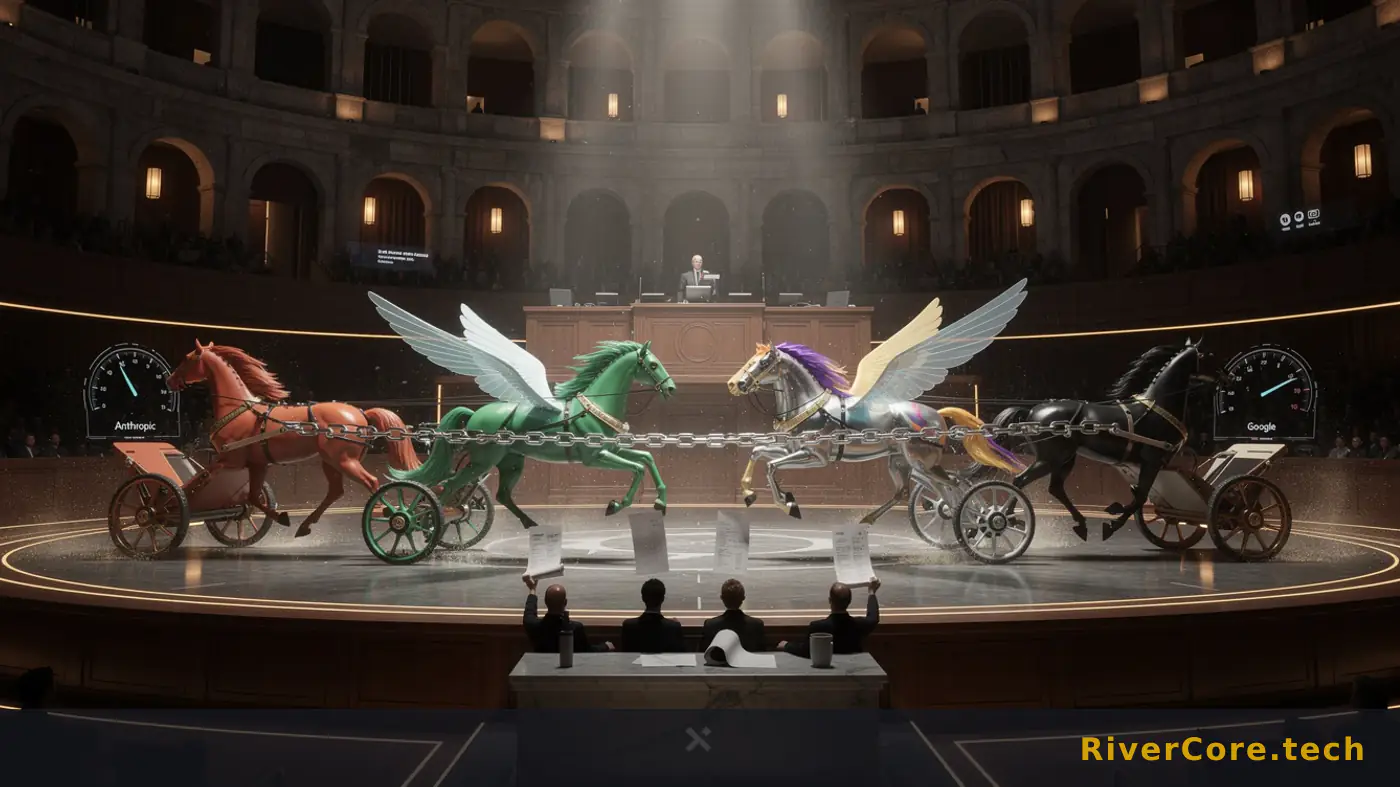
Four Subscribers Sue Big AI Over Alleged Slowdown Pact
Four chatbot subscribers filed a class action claiming Anthropic, OpenAI, Google and xAI agreed to hold their models back. Section 1 of the Sherman Act meets AI safety.