
Japan Hits 950K Cloud Native Devs While Staying On-Prem
The headline number out of Yokohama last week reshapes a conversation every platform lead has been having with their CFO since 2024: whether cloud native maturity requires committing to hyperscaler spend. Japan just answered no. And for any engineering org sitting on depreciated data center assets while being asked to ship production AI, that answer is worth six to eight figures of avoided migration cost.
What Happened
At KubeCon + CloudNativeCon Japan on July 28, the Cloud Native Computing Foundation and SlashData dropped the State of Cloud Native Development in Japan report. The topline, as PR Newswire reported, is that Japan now hosts roughly 950,000 cloud native developers as of Q1 2026, representing 41% of the country's total developer population. That edges past the 39% global average.
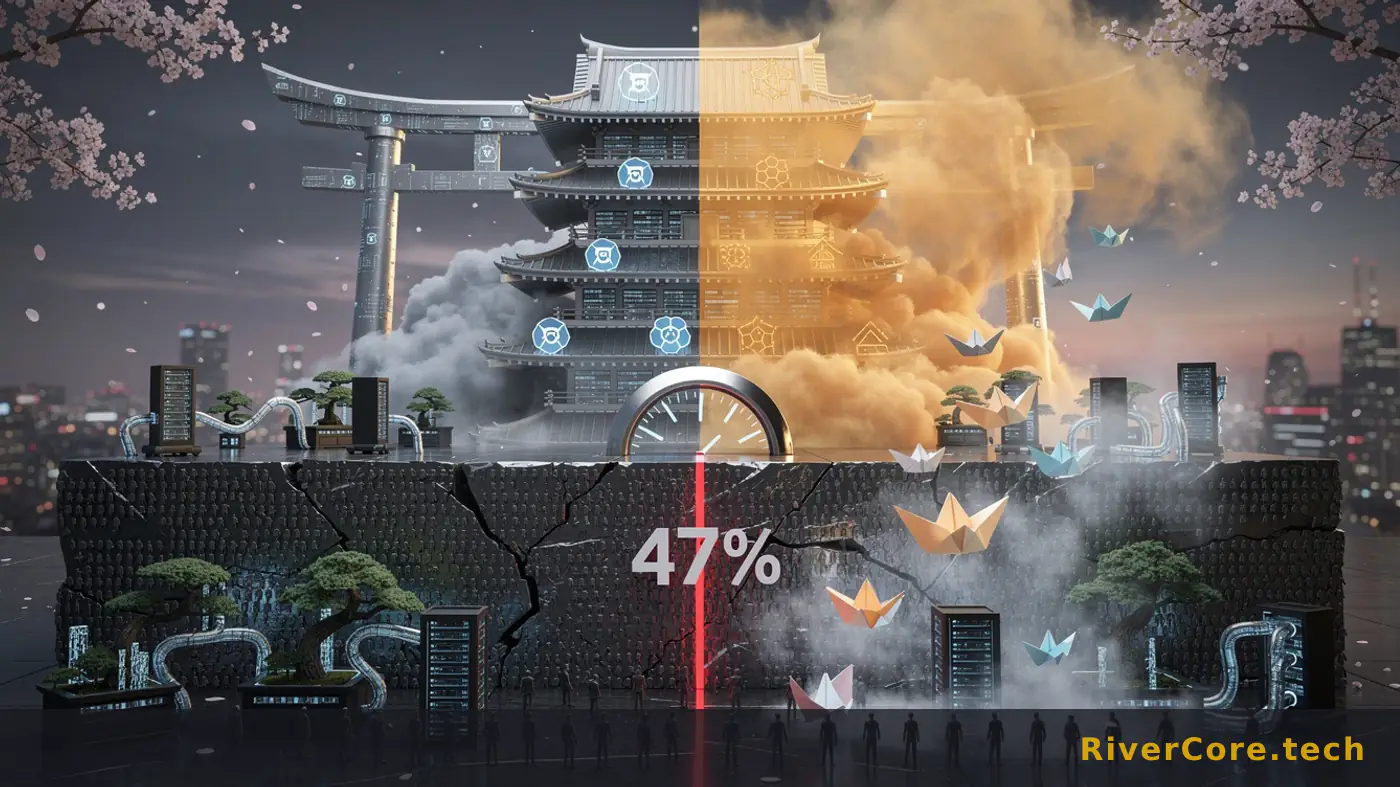
The interesting fact is not the headcount. It's the deployment mix. 47% of Japanese developers report deploying to on-premises servers. Hybrid cloud sits at 16%. So a country whose cloud native adoption rate now exceeds the global average is doing it primarily without the public cloud, or at least without exclusive dependence on it.
Platform engineering has been the quiet enabler. 88% of backend developers in Japan now work inside standardized DevOps or platform engineering environments, up from 80% just six months earlier. 71% use at least one cloud native technology or practice. And roughly 100,000 AI developers in the country are already cloud native, which frames the AI story as an infrastructure story, not a model story.
CNCF executive director Jonathan Bryce framed it directly: "In Japan, the focus is shifting from the novelty of AI models to the operational reality of production." He added that "AI is a driving factor for cloud native adoption with high-scale inference demands for observability and scalability that only a cloud native infrastructure stack can provide," and that organizations increasingly recognize Kubernetes as "the standard operating system for AI." Liam Bollmann-Dodd, principal market research consultant at SlashData, summarized the divergence: "Japan demonstrates that there is no single path to cloud native maturity."
Technical Anatomy
The Japan pattern only makes sense once you stop treating "cloud native" and "public cloud" as synonyms. They aren't. Cloud native is a set of abstractions: declarative infrastructure, container orchestration, service meshes, observability primitives. Public cloud is a billing relationship. A well-run Kubernetes cluster on bare metal in a Tokyo colo delivers the same workload portability as one on GKE, minus the egress fees and the FX exposure on a USD-denominated bill.
What Japan has apparently built, at scale, is the platform engineering layer that lets those two models look identical to a backend developer. That's the 88% figure doing work. When a developer ships against an internal developer platform, they don't know or care whether the underlying node pool is EC2 or a rack in Osaka. The abstraction is the product.
For AI workloads specifically, this matters more than it did for stateless web services. Inference at scale is bandwidth-bound and latency-sensitive. GPU capacity is scarce and expensive whether you rent it or own it. If you already have the physical infrastructure, the marginal cost of adding a GPU node behind an existing cluster is dramatically lower than paying hyperscaler markup on H100 time. Cloud native tooling, Prometheus for observability, Envoy for traffic management, Kubernetes for scheduling, works identically in both environments.
The catch is operational maturity. Running your own Kubernetes control plane, handling upstream CVE cycles, managing etcd, doing capacity planning for GPUs, none of this is free. It costs headcount. Japan's numbers suggest the country has been quietly investing in that headcount for years while Western teams outsourced the same work to AWS bills.
Who Gets Burned
Three groups should be uncomfortable reading this report.
First, hyperscaler account executives selling into Japanese enterprises on a "cloud is inevitable" pitch. That narrative is empirically weaker now. The counter-argument, that serious cloud native maturity can coexist with on-prem dominance, has a 950,000-developer dataset behind it. Renewal conversations in the next 90 days get harder.
Second, Series B and C fintech and iGaming platforms outside Japan that have committed to single-cloud architectures without an exit ramp. If your AI inference bill is now a material line item and your board is asking why gross margins are compressing, the Japan model is a live counterexample. Not a mandate to repatriate, but a mandate to price the option. Vendor lock-in has a number, and that number just got easier to defend against internally.
Third, and less obviously, US and European engineering leaders trying to hire platform engineers. The Japan data implies a mature domestic talent pool that can run production Kubernetes against physical infrastructure. That's exactly the skill set that gets scarce when every Western team decided in 2019 to just pay AWS instead. If AI cost pressure forces a partial repatriation cycle in 2027, the hiring market for engineers who can actually run a bare-metal K8s cluster is going to be brutal. Compensation for that profile will move first.
The CFO at any licensed fintech or iGaming operator running material inference workloads should be asking their VP Engineering this week a specific question: what would it cost, in headcount and capex, to move 30% of inference traffic off the public cloud in 18 months, and what would it save on a three-year TCO. Not because the answer is obviously yes. Because not knowing the answer is now a governance gap.
Playbook for Engineering Teams
Concrete moves for the next quarter.
Audit your workload portability honestly. If you're on managed Kubernetes, how many managed services have you pulled in around it? Every proprietary queue, every vendor-specific IAM binding, every serverless glue function is a chain on the exit. Price the chains. Reference architectures from providers like Google Cloud are useful precisely because they show you what's portable and what isn't.
Separate the AI inference cost center from the general compute cost center in your FinOps reporting. The economics are different, the growth curve is different, and the negotiation use is different. Treating them as one line hides the trade you might want to make.
If you don't have a platform engineering function with a real internal developer platform, the Japan data is your business case. 88% of backend developers working inside a standardized environment is not a nice-to-have, it's the substrate that makes deployment topology a strategic variable rather than a lock-in. Fund it.
For hiring, start tracking candidates with bare-metal or colo Kubernetes experience separately in your ATS. That signal is going to matter in 2027. Better to build the bench now while the market hasn't fully repriced.
Finally, revisit your assumption that on-prem means legacy. It doesn't, in Japan, and it increasingly doesn't anywhere. The question teams evaluating AI infrastructure strategy should now be asking themselves is not "cloud or on-prem" but "which workloads deserve which economics, and does our platform layer let us move them without a rewrite."
Key Takeaways
- Japan has roughly 950,000 cloud native developers at 41% of its developer base, above the 39% global average, while 47% still deploy to on-prem servers.
- 88% of Japanese backend developers work in standardized DevOps or platform engineering environments, up from 80% six months earlier, evidence that the internal developer platform is the enabler.
- Roughly 100,000 AI developers in Japan are cloud native, reinforcing CNCF's framing of Kubernetes as the operating system for production AI workloads.
- The vendor lock-in conversation for AI inference just gained an empirical counterexample. Any single-cloud commitment now needs an explicit TCO defense.
- Engineering leaders should price the option of partial repatriation before the talent market for bare-metal Kubernetes operators tightens.
Frequently Asked Questions
Q: Why is Japan's cloud native adoption growing despite heavy on-prem use?
Japanese organizations have invested in platform engineering as an abstraction layer, letting them run cloud native tooling like Kubernetes, Prometheus, and Envoy on existing on-premises infrastructure. The result is workload portability and modern developer experience without a full migration to public cloud.
Q: What does the report say about AI developers specifically?
SlashData and CNCF estimate that approximately 100,000 AI developers in Japan are cloud native. CNCF executive director Jonathan Bryce framed this as evidence that production AI at scale requires cloud native infrastructure for observability and scalability, with Kubernetes emerging as the de facto operating system for AI workloads.
Q: Should Western engineering teams reconsider public cloud commitments based on this data?
Not automatically, but the Japan pattern is a live counterexample that cloud native maturity does not require exclusive public cloud dependence. Platform leaders should at minimum price the TCO of partial repatriation for high-cost inference workloads and audit how much vendor-specific tooling has crept into their stack.

PostgreSQL 19 Ships Without SQL/PGQ: The Right Call
PostgreSQL 19 drops SQL/PGQ over unresolved bugs but ships REPACK CONCURRENTLY, ending the midnight VACUUM FULL pager. Here's what platform teams should plan for.

Dutch Regulator Renews Eight iGaming Licenses to 2031
The KSA has renewed eight Dutch online gambling licenses through 2031, including Bet365 and Holland Casino, even as self-exclusion failures resurface.

Microsoft Patches CVSS 10.0 Azure AI Foundry Auth Bypass
A perfect-10 auth bypass in Azure AI Foundry, three more critical cloud flaws, and an active exploit kit called BlueMoon. Microsoft's week gets worse.