
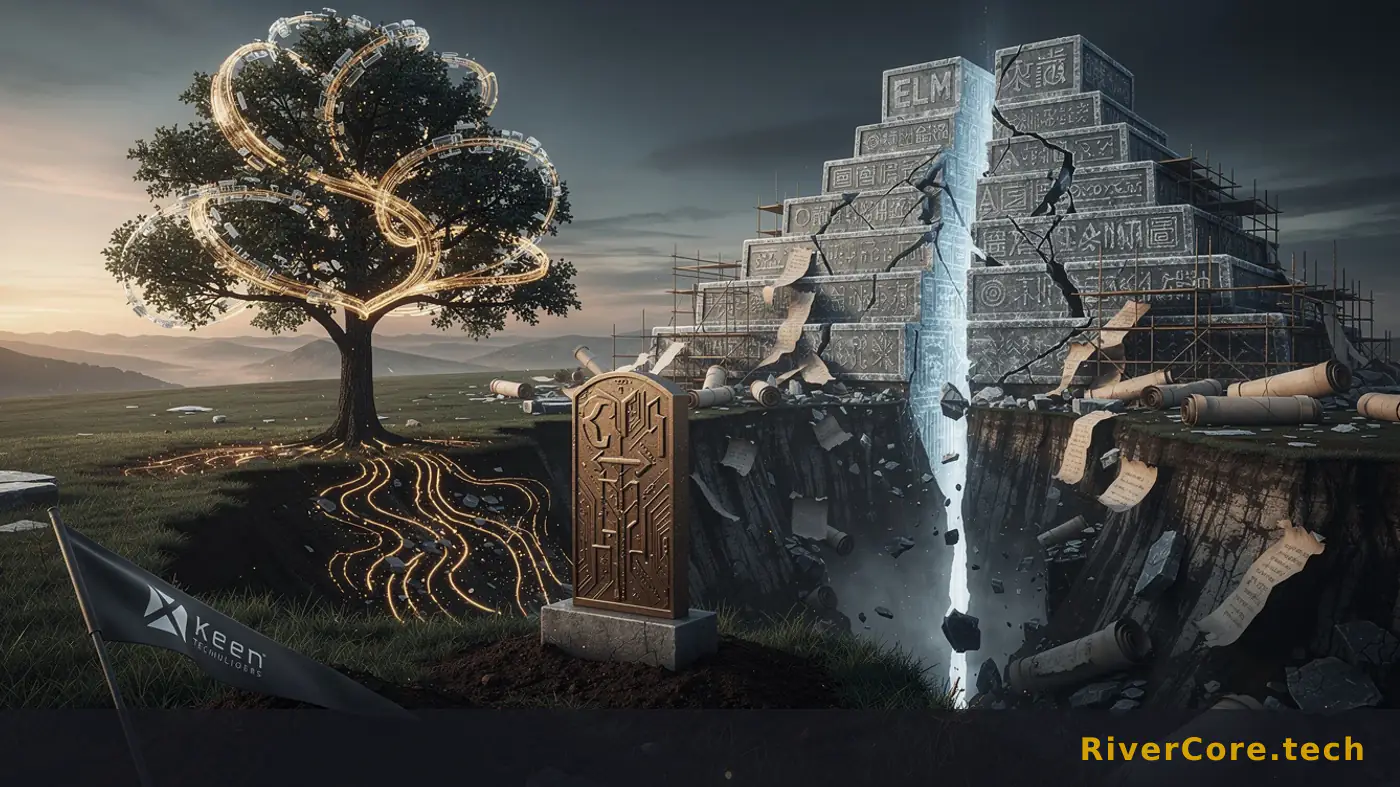
Sutton Quits Carmack's Lab to Declare War on LLMs
Think of the AI industry right now as a huge motorway: eight lanes, all going the same direction, everyone flooring it toward bigger transformers and more scraped text. On July 14, a 68 year old man in Alberta pulled off at the next junction, turned the car around, and started driving the other way. That man happens to have a Turing Award on the passenger seat.
Richard Sutton, the person most people in the field would name if you asked who invented reinforcement learning, has walked out of John Carmack's AI startup to build something that looks nothing like GPT. And he is not being subtle about why.
What Happened
As BigGo Finance reported, Sutton announced on X that he and collaborator Khurram Javed are leaving Keen Technologies, the AI outfit founded by legendary game developer John Carmack, to co-found Oak Lab. The new company is registered in Canada, where Sutton has spent his academic career as a professor of computer science at the University of Alberta.
The credentials matter here because the claim is enormous. Sutton did his undergrad in psychology at Stanford, then a PhD at UMass Amherst under Andrew Barto. He originated the temporal difference learning algorithm, co-wrote Reinforcement Learning: An Introduction with Barto, and in 2025 the pair jointly received the ACM Turing Award for their foundational contributions to reinforcement learning. His former students include David Silver, who built AlphaGo and has now founded Ineffable Intelligence, and Doina Precup, who runs DeepMind Montreal.
Oak Lab is built around an architecture called OaK, short for Options and Knowledge, which comes out of the "Alberta Plan" research roadmap. The stated long-term goal is an agent with a trillion parameters running on 20 watts, the same power budget as the human brain. Sutton wants real-time learning with a batch size of one. No pretraining ceremony, no frozen weights, no "ship it and stop learning."
He has been laying the ground for this for a while. In a September 2025 interview with Dwarkesh Patel he argued that LLMs do not embody the spirit of his 2019 essay "The Bitter Lesson." In May 2026 at MIT's Dertouzos Distinguished Lecture, he said out loud that AI as a massive industry has to some degree lost its way. Oak Lab is what that sentence looks like when you put money and engineers behind it.
Technical Anatomy
To understand the bet, you have to understand the road Sutton says the industry took the wrong exit on. "The Bitter Lesson" reviewed 70 years of AI research and concluded that hand-coded human knowledge always loses to general methods plus scale. The frontier labs read that essay and heard: scale transformers. Sutton read his own essay and hears something quite different: learn from experience, not from other people's homework.
The guts of OaK rest on three principles. The agent must be general-purpose with no pre-programmed domain-specific knowledge. All knowledge must come from experience. And the driving force is the maximization of cumulative reward. "Options" in the name refers to temporally extended behavioral policies, sequences of actions with termination conditions rather than one-step twitches. "Knowledge" is what the agent builds up as it runs those options against the world.
The batch-size-of-one requirement is where it gets spicy. Anyone who has trained a modern network knows that batch size one is the part where it all falls over. Gradient noise eats you alive. Modern deep learning is essentially a very fancy averaging machine, and averaging over a batch of one is called "not averaging." Sutton and his team believe combining their algorithms with event-driven neural networks could drop required computation and energy consumption by several orders of magnitude. That is the only credible path to 20 watts. You cannot get to brain-power budgets by shaving transistors on an H100 successor. You get there by not doing the work in the first place.
The two problems Sutton openly acknowledges are catastrophic forgetting, where new learning overwrites old knowledge, and plasticity loss, where a network gradually stops being able to learn anything new. Both are unsolved in a serious way. LLMs sidestep them by simply not learning after training. Oak Lab has to face them head on, because continual learning is the whole point. A report by 36Kr covered the long-term ambition, but the near-term research problem is brutal, and honest people in the field will tell you nobody has cracked it.
Who Gets Burned
Short answer: not the frontier labs, at least not yet. OpenAI, Anthropic and Google are not going to notice a Canadian research startup on their revenue reports next quarter. The people who should be paying attention are the ones one layer down.
Start with the agent frameworks. A lot of what is being sold as "AI agents" in 2026 is a language model in a loop with tools and a memory hack. If Sutton and Silver are right that genuine continual learning matters, then those systems are essentially very sophisticated puppets. They cannot learn from a user, cannot correct their own outputs, cannot invent new strategies. AlphaZero abandoned human game records and found better chess than humans ever played. No LLM agent shipping today does the equivalent. Founders building on the Claude or Gemini agentic stacks should at least ask themselves what their moat looks like if the whole approach is a local maximum.
Second, the RLHF and fine-tuning shops. If reinforcement learning as a first-class citizen makes a comeback, the "add a preference model on top of a base LLM" cottage industry gets squeezed from both sides. The frontier labs will keep doing it in-house, and a new wave of RL-native systems will make the veneer look thin.
Third, and this is where it gets interesting for fintech and iGaming teams: the promise of an agent that learns online, in real time, from its own actions, with a batch size of one, is exactly the shape of problem those verticals have. Fraud detection, in-play pricing, personalization loops. Nobody in those verticals actually wants a frozen model. They want a system that adapts to today's traffic, not last quarter's. If Oak Lab produces anything usable in the next three years, the applied AI teams in payments and betting will be the first commercial customers, not consumer chatbot companies.
Playbook for AI Development
Nobody should rip out their LLM stack this week. That would be daft. But there are three moves worth making.
One: read "The Bitter Lesson" and the September 2025 Dwarkesh interview yourself before letting your architects tell you what Sutton means. The essay is being cited by two opposite camps to justify opposite conclusions. That is a hint that you should form your own read.
Two: audit which parts of your AI system genuinely need continual learning and which are fine being frozen. Most product features do not need it. Some do, and those are the parts where LLM plus vector database is currently duct tape. Be honest about which is which. If you are running fine-tunes through Hugging Face pipelines every week just to keep your model current, that is a signal you are working against the approach, not with it.
Three: keep an eye on Ineffable Intelligence and Oak Lab together. The source describes them as a coordinated challenge to the dominant AI approach. Two Turing-lineage teams pointing the same direction is not a rounding error. It might produce nothing shippable for five years. It might also produce the thing that eats a big chunk of what you are building on today.
Key Takeaways
- Sutton and Khurram Javed left Keen Technologies on July 14 to co-found Oak Lab in Canada, built around the OaK (Options and Knowledge) architecture from the Alberta Plan.
- The long-term target is a trillion-parameter agent running on 20 watts, matching the human brain's energy budget, with real-time learning at batch size one.
- Sutton argues LLMs violate the spirit of his 2019 essay "The Bitter Lesson" because they learn from human data rather than experience.
- The move parallels David Silver's Ineffable Intelligence, forming a coordinated challenge from the reinforcement learning old guard.
- Catastrophic forgetting and plasticity loss remain openly unsolved, so this is a research bet on a decade horizon, not a next-quarter threat to the frontier labs.
Back to that motorway. Everyone is still hurtling in the same direction, and the exits are quiet. But when the person who wrote the manual for one of the two general methods that scale indefinitely turns his car around at 68 years of age, you at least glance in the rearview.
Frequently Asked Questions
Q: Who is Richard Sutton and why does his move matter?
Sutton is widely considered the father of reinforcement learning and a 2025 ACM Turing Award laureate alongside Andrew Barto. His students include AlphaGo creator David Silver and DeepMind Montreal head Doina Precup, so when he abandons the mainstream LLM approach to start Oak Lab, the field pays attention.
Q: What is the OaK architecture?
OaK stands for Options and Knowledge and comes from the Alberta Plan research roadmap. It rests on three principles: no pre-programmed domain knowledge, all learning from experience, and reward maximization as the driving force. Options are temporally extended action sequences, and knowledge is what the agent accumulates while executing them.
Q: Should engineering teams stop using LLMs because of this?
No. Oak Lab is a research bet on a multi-year horizon and has not shipped anything. But teams should honestly audit which product features genuinely need continual learning versus a frozen model, because that is where the LLM approach is weakest and where a Sutton-style approach could eventually compete.
Multi-Model AI Just Became a Platform Problem, Not a Vendor One
Anthropic shipped Opus 5.5, OpenAI shipped GPT-6 Sol and Luna, and Palo Alto Networks quietly admitted no single model catches more than 40% of vulnerabilities.
Gemini 3.8 Live Hits $0.023/Min: Google Undercuts Voice AI Stack
Google shipped Gemini 3.8 Live at $0.005/min input and $0.018/min output, plus a 2.6% WER transcription model. The economics of cascaded voice stacks just got harder to defend.
Four Subscribers Sue Big AI Over Alleged Slowdown Pact
Four chatbot subscribers filed a class action claiming Anthropic, OpenAI, Google and xAI agreed to hold their models back. Section 1 of the Sherman Act meets AI safety.