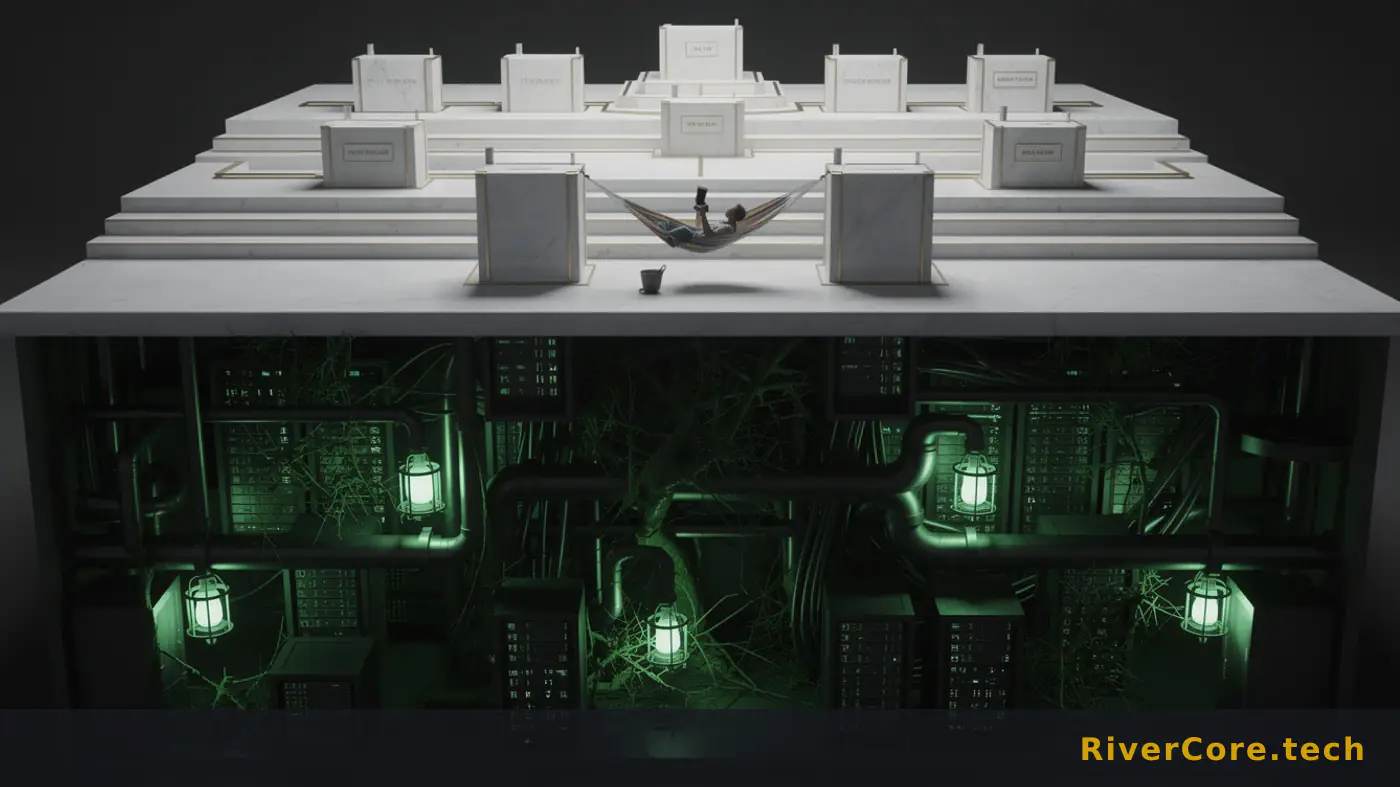

WEKA's 6.5x GPU Token Multiplier Changes the AI Storage Game
WEKA's March 16 announcement landed with a specific number that should make every AI infrastructure team pause: 6.5x more tokens per GPU for inference workloads. That's not an incremental improvement. That's the kind of multiplier that rewrites deployment economics for teams burning through H100 allocations like venture capital.
The San Jose storage vendor is pushing its NeuralMesh AI Data Platform as the missing link between proof-of-concept demos and production AI factories. Built on NVIDIA's AI Data Platform reference design, it's positioned as turnkey infrastructure for enterprises that have proven their models work but can't scale them profitably.
What Happened
WEKA announced general availability of NeuralMesh on March 16, 2026, as HPCwire reported, positioning it as an enterprise-ready solution based on NVIDIA's reference architecture. The platform promises to compress AI project timelines from months to minutes, a claim backed by that 6.5x token multiplier when running with their Augmented Memory Grid.
The timing aligns with broader industry signals. SoftServe's April 14 report shows 98 percent of enterprises expect agentic AI to accelerate software delivery within two years. Meanwhile, Cloudera found nearly 80 percent of enterprises say AI is held back by data access challenges. WEKA is betting those two data points create a perfect storm of demand.
"Enterprises are now deploying AI Factories internally, driving a major shift to inference throughout the ecosystem," said Liran Zvibel, WEKA's cofounder and CEO. The platform includes ready-to-use pipelines for semantic search, video search and summarization, AlphaFold for drug discovery, and agentic RAG implementations.
WEKA built NeuralMesh on more than 170 patents accumulated over a decade of AI-native storage development. The company claims 30 percent of the Fortune 50 already trust NeuralMesh, though the source doesn't specify whether that's for this new platform or WEKA's broader storage portfolio.
Technical Anatomy
The 6.5x token multiplier reveals the real engineering story here. Traditional storage architectures force GPUs to wait on data movement, creating the infamous "GPU starvation" problem where your $40,000 accelerator spends most cycles idle. WEKA's Augmented Memory Grid appears to function as a massive cache layer that keeps inference context hot and local to compute.
The platform integrates NVIDIA RTX 6000 PRO Server Edition GPUs alongside the newly announced RTX 4500 PRO Server Edition units. This isn't the typical H100/A100 deployment we see in training clusters. WEKA is betting on inference-optimized hardware that trades raw FLOPS for better memory bandwidth and lower power consumption.
NeuralMesh ships as an appliance-style system with partnerships spanning Red Hat, Spectro Cloud, and Supermicro. The appliance model matters because it sidesteps the integration tax that kills most AI infrastructure projects. Teams get pre-validated configurations instead of spending months debugging driver conflicts and network bottlenecks.
Jason Hardy, VP of storage technologies at NVIDIA, emphasized the platform's focus on "continuous, coherent flow of data and inference context." That's NVIDIA-speak for solving the context window problem in production agentic systems. When agents need to maintain state across millions of interactions, traditional object storage architectures break down. You need something that treats context as a first-class citizen, not an afterthought.
The source doesn't disclose specific latency numbers or IOPS benchmarks, which would help validate the 6.5x claim. We also don't know the baseline they're measuring against, though industry standard would be comparing to S3-compatible object stores or traditional NFS deployments.
Who Gets Burned
Pure Storage and NetApp face the most immediate pressure. Both have been retrofitting traditional storage architectures for AI workloads, but WEKA's 170-patent portfolio suggests they built for this use case from day one. Pure's FlashBlade and NetApp's ONTAP AI weren't designed with inference context persistence as a core primitive.
Cloudera's finding that 80 percent of enterprises cite data access as their AI bottleneck puts every traditional storage vendor on notice. If WEKA can deliver even half the promised acceleration, it resets customer expectations for what storage should contribute to AI economics.
Inference platform companies like BentoML, Seldon, and KServe might need to rearchitect their caching layers. They've been solving the context problem in software because the storage tier couldn't keep up. A 6.5x improvement at the infrastructure layer obsoletes many of their optimizations.
The real casualties might be the hyperscalers' AI services. AWS SageMaker, Google Vertex AI, and Azure ML all assume relatively slow storage tiers compensated by aggressive instance-local caching. If enterprises can get 6.5x better token throughput on-premises, the cloud providers' margin advantage evaporates. They'll need to either adopt similar technology or accept being relegated to training workloads only.
Playbook for Data Teams
Start by auditing your current inference infrastructure costs. Calculate tokens per dollar, not just tokens per second. If you're running inference on cloud platforms, model what a 6.5x efficiency gain would mean for your monthly bills. That number becomes your budget justification for evaluating on-premises alternatives.
Request benchmarks from WEKA using your specific model architectures. The 6.5x claim needs validation against your workload patterns. Focus on 95th percentile latencies under production load, not just throughput numbers. Inference SLAs live and die on tail latencies.
For teams already running NVIDIA hardware, investigate whether NeuralMesh can layer onto existing deployments. The RTX 6000 and 4500 PRO GPUs suggest this targets different workloads than H100 training clusters. You might keep cloud for training while moving inference on-premises.
Consider the operational complexity tradeoff carefully. Appliance systems reduce integration burden but create vendor lock-in. Evaluate whether your team has the expertise to operate yet another storage tier, even if it's supposedly turnkey. The source mentions Red Hat and Spectro Cloud partnerships, suggesting Kubernetes integration, but operational details remain sparse.
Key Takeaways
- WEKA claims 6.5x more tokens per GPU for inference workloads with NeuralMesh, though baseline comparison and testing methodology aren't disclosed
- Platform targets the gap between AI proof-of-concept and production, where 80 percent of enterprises report data access blocks progress
- Built on 170 patents with NVIDIA reference architecture, includes RTX 6000 and 4500 PRO GPUs rather than traditional H100/A100 training hardware
- If performance claims hold, this could shift inference workloads back on-premises and force cloud providers to revisit their AI service economics
- Watch for independent benchmarks in Q2 2026: if multiple customers validate the 6.5x claim, expect Pure Storage and NetApp acquisition attempts by year-end
Frequently Asked Questions
Q: What makes WEKA's 6.5x token claim significant for production AI deployments?
Most enterprises see GPU utilization below 30 percent in inference due to storage bottlenecks. A 6.5x improvement means the same GPU fleet could handle 6x more user requests, fundamentally changing the unit economics of AI products. However, WEKA hasn't disclosed what baseline they're measuring against.
Q: How does NeuralMesh differ from traditional storage approaches for AI?
Traditional storage treats AI workloads like any other data access pattern. NeuralMesh appears purpose-built for maintaining inference context across millions of agent interactions, with their Augmented Memory Grid keeping frequently-accessed context hot and local to compute resources.
Q: Should teams consider this for training workloads or just inference?
The hardware choices (RTX 6000 and 4500 PRO) and emphasis on inference context suggest this targets production inference, not training. Teams doing distributed training on H100 clusters should evaluate separately, as the optimization goals differ significantly between training and inference infrastructure.