
Coinbase Q1: A $394M Loss and an AWS Outage on the Same Card
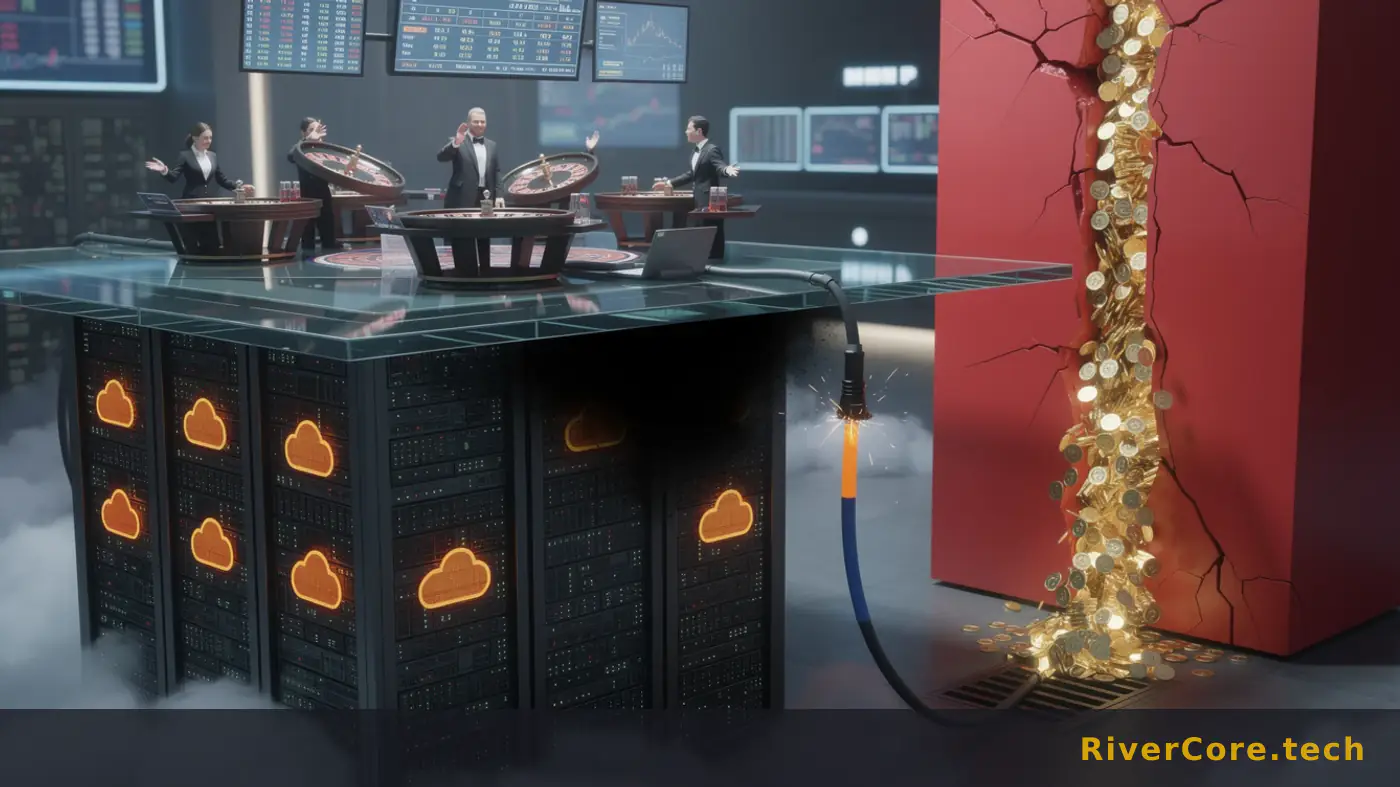
Picture a casino built on top of a power station you don't own. The lights stay on most nights, the roulette wheel spins, the cashier counts chips. Then one Tuesday the grid hiccups, and suddenly nobody can cash out, nobody can place a bet, and the floor manager is on the phone to a utility company that doesn't return calls. That's roughly the quarter Coinbase just had.
What Happened
Coinbase posted a loss of $394 million for the first quarter, and in the same window suffered an outage tied to Amazon Web Services, as Investing News Network reported. Two stories, one quarter, and they rhyme more than the headlines suggest.
The financial number is the kind of figure that makes a board meeting go very quiet. A near four hundred million dollar hole in a single quarter at a publicly listed exchange is not a rounding error. It's a signal that the unit economics of being the regulated front door to crypto in the United States are wobblier than the equity story has been pretending.
The AWS outage is the part that should bother engineers more, even if it bothers shareholders less. When the largest US exchange goes dark because someone else's us-east-1 has a bad afternoon, the entire premise of "regulated, institutional grade infrastructure" takes a knock. Customers don't see a cloud provider failing. They see Coinbase failing.
Two distinct events, then. One on the P&L, one on the status page. Both pointing at the same underlying question: how resilient is the operational backbone of centralised crypto when the macro tide goes out and the dependencies start failing in sequence?
Technical Anatomy
Anyone who has run a matching engine on rented hardware knows the boring bit nobody talks about at conferences: cloud regions are not magic. They're datacentres with SLAs, and SLAs are insurance policies, not uptime guarantees. When AWS sneezes, every tenant in that region catches it, and the blast radius depends entirely on how the tenant designed around the failure mode.
An exchange like Coinbase has, broadly, three classes of system that hate downtime. There's the order book and matching engine, where milliseconds matter and stale state is poison. There's the wallet and custody layer, where signing infrastructure has to be both available and locked down. And there's the consumer-facing app and API edge, which is what most retail users actually experience as "the site". An AWS regional event can take out any of these depending on where the dependencies live: RDS, DynamoDB, S3, KMS, IAM, the lot.
The guts of it: if your hot path touches a single region's control plane, you don't have multi-region. You have multi-region marketing. True active-active across regions for a financial venue is genuinely hard. You need conflict-free state replication, deterministic ordering, key material that can sign in more than one place without getting your custody team fired, and a failover drill you've actually run with real traffic. Most teams have one or two of those. Almost nobody has all four.
The financial side has its own anatomy. A $394 million quarterly loss at a venue whose revenue is heavily tied to retail trading volume and stablecoin yields tells you the mix is fragile. Trading fees are cyclical, interest income is rate-sensitive, and custody fees are a slow drip. When volumes soften and ops costs (legal, compliance, infra) stay sticky, the operating use works in reverse. The casino still has to pay the dealers when the floor is empty.
The regulatory backdrop doesn't help. Anyone reading the SEC's rulemaking docket over the last two years knows compliance spend at US-domiciled exchanges has only gone one direction.
Who Gets Burned
Start with Coinbase's own platform team. A loss of that size combined with a public infrastructure incident is the worst possible context for the next budget cycle. SREs will be asked to do more with less, right at the moment they need to be investing in genuine multi-region resilience and ideally bare-metal colocation for the latency-sensitive bits. Anyone who has tried to negotiate a colo contract during a cost-cutting quarter knows how that conversation goes.
Next, the integrators. Every fintech, neobank, and payments company that white-labels Coinbase rails for crypto on/off ramps just had a live demonstration that their dependency has a single cloud provider as a single point of failure. Product managers at those firms are going to spend the next ninety days drawing dependency diagrams they should have drawn a year ago. Some will quietly add a second venue.
Then the institutional desks. Prime brokers and market makers running on Coinbase Prime saw an outage they couldn't trade through. For a market maker, downtime isn't an inconvenience, it's directional risk you didn't choose to take. Expect tighter SLA clauses, more aggressive failover requirements, and a fresh look at venues like Kraken, Bullish, and offshore liquidity for hedging legs.
DeFi protocols feel this too, even if indirectly. A lot of "decentralised" frontends quietly rely on Coinbase Wallet SDK, Coinbase-operated nodes, or Base sequencer infrastructure. When the parent has a bad quarter, the children get less attention. Base in particular sits in an awkward spot: an L2 whose operator just told the market it lost nearly four hundred million dollars in three months. Builders shipping on Base will be asked harder questions by their investors this month than last.
Playbook for Crypto and DeFi
If you're a CTO or platform lead in this space, here's the part where it all falls over for teams who aren't paying attention. A few things worth doing this week.
Audit your cloud blast radius honestly. Not the architecture diagram, the actual runtime. Run a query: which of our critical paths terminate in a single AWS region? KMS keys, secrets managers, primary databases, queue infrastructure. If the answer is "most of them", you're one bad afternoon away from a Coinbase-shaped headline of your own.
For exchanges and custodians specifically, look hard at active-active across at least two cloud providers for the read path, and at minimum warm-standby for the write path. It's expensive. It's also cheaper than a public outage during a volatility spike when liquidations are queueing.
For DeFi teams, this is an argument for the boring discipline of decentralised RPC. Don't ship a frontend that pins to a single Infura, Alchemy, or Coinbase Cloud endpoint. Use a router, fail through, and consider running your own node for the hot path. The Ethereum docs on client diversity exist for a reason that just got reinforced.
Counterparty risk on centralised venues deserves a fresh look. If your treasury sits on one exchange, split it. If your trading strategy assumes Coinbase is always reachable, write the runbook for the day it isn't. You just got a free dress rehearsal.
Key Takeaways
- Coinbase reported a $394 million Q1 loss and an AWS-linked outage in the same quarter, two distinct stories that compound each other.
- Single-region cloud dependencies remain the unglamorous failure mode behind most "exchange went down" incidents, regardless of how mature the venue looks on paper.
- Integrators, market makers, and Base-native builders carry the downstream consequences of Coinbase's quarter, whether they signed up for that exposure or not.
- True active-active across regions and providers is hard, expensive, and increasingly non-optional for any platform handling custody or matching.
- The casino can't blame the power station forever. If your business depends on someone else's grid, you own the outage when the lights go out.
Frequently Asked Questions
Q: How big was Coinbase's Q1 loss?
Coinbase reported a loss of $394 million for the first quarter. It's a substantial hit for a publicly listed exchange and it landed in the same window as a separate AWS-related outage.
Q: What caused the Coinbase outage?
The outage was linked to Amazon Web Services infrastructure rather than to Coinbase's own application code directly. That distinction matters less to end users, who experience any downtime as a Coinbase failure regardless of the upstream cause.
Q: What should engineering teams take away from this?
Audit your real cloud blast radius, not the diagram version. Any critical path that terminates in a single region of a single provider is a public incident waiting for a bad afternoon, and exchanges and DeFi frontends are particularly exposed.

Google and Apple Post Crypto Job Ads: Big Tech Eyes Stablecoin Rails
Google Cloud wants a Web3 architect in Hong Kong. Apple wants a payments strategy lead in Cupertino. The job ads say more about stablecoin infrastructure than any press release would.

Buterin: AI Agents Replace Wallets, Talk Directly to SDKs
Vitalik Buterin says AI will replace wallet UIs entirely, agents will hit SDKs directly, and ZK payments become the native settlement layer for autonomous agents.

Treasury Sanctions BitBank as Iran's Bitcoin Pipeline Grows
OFAC designated Iranian exchange BitBank under Operation Economic Outcast, targeting a bitcoin laundering pipeline active since June. The technical problem: BTC can't be frozen.