
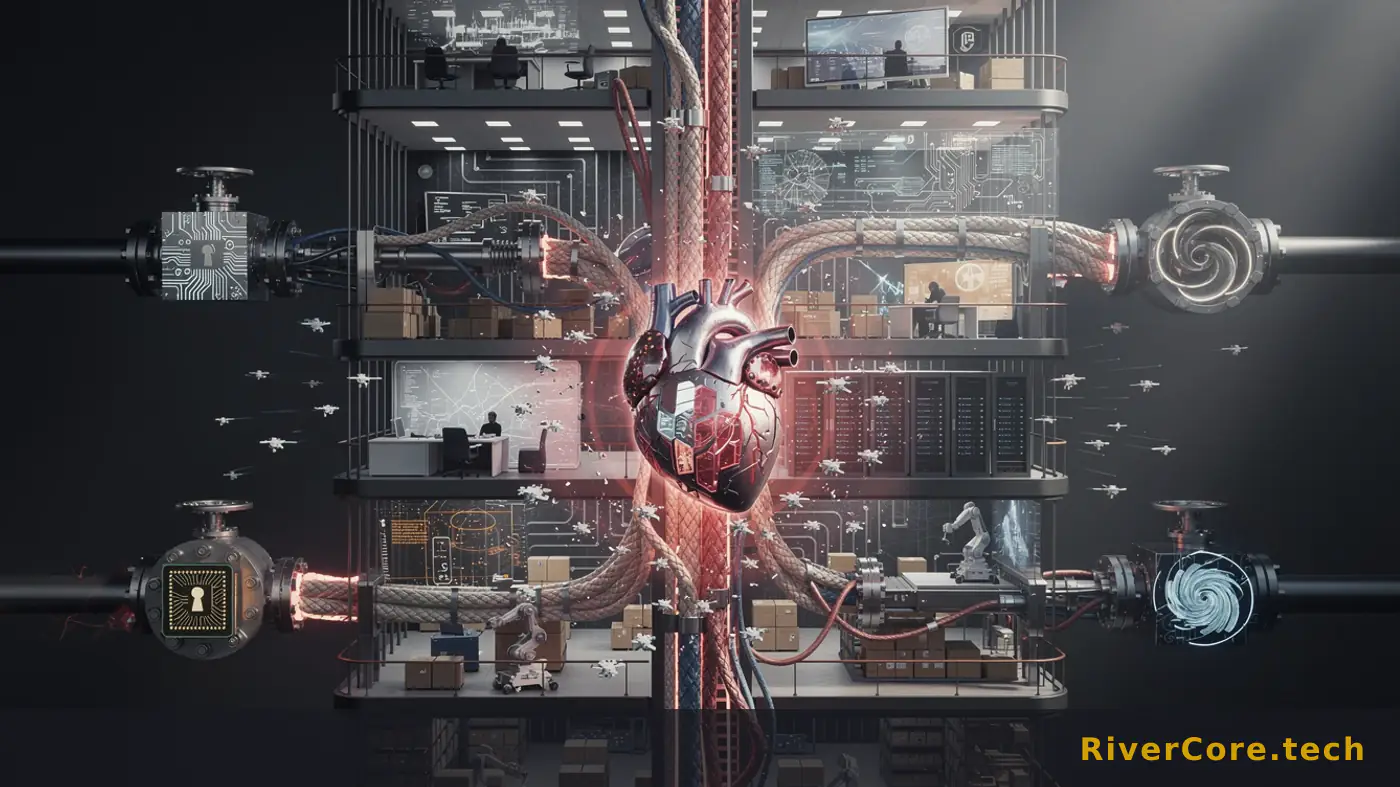
The Automation Layer Wants To Own Enterprise AI
Every generation of enterprise software has its motorway junction, the moment when four separate roads decide they'd rather share one interchange than keep laying tarmac in parallel. Kubernetes was one. The identity plane around SAML and OAuth was another. What Automation Anywhere just announced with Cisco, NVIDIA, Okta and OpenAI looks like the early concrete pour for the next one, and the traffic they're routing is autonomous agents.
Call it the AI interchange. It's where reasoning, compute, identity and connectivity are being welded into a single on-ramp, and whoever owns the tollbooth owns the next decade of enterprise operations.
What Happened
Automation Anywhere used its 2026 platform roadmap to unveil a set of enhancements aimed squarely at AI-driven enterprise processes, and alongside it launched a new initiative called EnterpriseClaw. As DevOps.com reported, EnterpriseClaw is tied to partnerships with four vendors that each represent a different structural layer of what an enterprise AI stack actually needs to run in production.
OpenAI is positioned as the reasoning layer. NVIDIA sits underneath as compute infrastructure and runtime acceleration. Okta handles identity and trust. Cisco covers networking, connectivity and the operational plumbing that most engineers only think about when it breaks.
The author of the original piece had spent the previous several weeks on the road talking to enterprise IT leaders, platform engineers, security teams and software vendors. The observation driving the story is simple. Six months ago, most conversations about AI in the enterprise were about copilots, productivity boosts and experimentation. Now they're about execution. Teams want to know how agents can operate inside real systems without introducing operational instability or security exposure they can't contain.
That shift is the whole story. The announcement itself is easy to file next to a dozen other enterprise AI platform launches this year. The interesting bit is the shape of the alliance: reasoning plus compute plus identity plus connectivity, assembled deliberately, and pitched at teams who are already past the demo phase and staring down the boring bit of actually running the thing.
Technical Anatomy
For roughly the last fifteen years, enterprise automation has been a deterministic game. Infrastructure as code provisioned resources. CI/CD moved artefacts. Kubernetes scheduled containers. Even the more ambitious workflow tools ran inside bounded logic with predictable execution paths. When one of those systems failed, you could usually trace the blast radius, roll back, and go home.
Agentic AI kicks the legs out from under that model. Instead of automating a task, you're automating judgment. An agent decides which alert matters, which system to touch next, which remediation to attempt, and what to do when the first attempt returns something weird. The execution path is no longer a diagram you drew in Miro. It's a runtime negotiation between a probabilistic model, an identity provider, a network fabric and whatever business system happens to answer the API call.
That is why the four-way partnership reads like an architecture diagram in disguise. Reasoning without compute is a demo. Compute without identity is a security incident waiting to happen. Identity without connectivity is a policy document nobody enforces. Connectivity without reasoning is just, well, Cisco.
The piece from DevOps.com draws an explicit parallel to the cloud-native transition, and it's the right one. Kubernetes ended up mattering less for containers themselves and more because it became a control plane for coordinating operational complexity. Platform engineering emerged on top of it to hand developers standardised abstractions and operational guardrails. Anyone who has debugged a misbehaving Helm chart at 2am knows the control plane is where the real power sits.
In the agentic world, identity looks like it becomes that control plane. Every action an agent takes is a permission check. Every decision is an audit event. Every chain of calls is a trace that needs to be reconstructable after the fact. This is a job for proper distributed tracing and structured telemetry, and standards like OpenTelemetry are going to end up carrying a lot more weight than their maintainers probably signed up for. The interchange isn't reasoning. It's the identity-and-observability plane wrapped around it.
Who Gets Burned
The first group feeling the heat is the pure-play RPA vendor that hasn't figured out its agent story. Deterministic workflow automation is a solved problem. If your platform can't sit inside a governed agent runtime with a real identity model behind it, you're a feature, not a company. The EnterpriseClaw framing is Automation Anywhere planting a flag on that ground first.
The second group is the identity team inside every large enterprise. Most orgs do not have standardised identity models for AI agents operating with enterprise permissions. They have humans, they have service accounts, and they have a spreadsheet of API keys nobody wants to open. Agents don't fit any of those cleanly. Over the next ninety days, expect Okta-shaped conversations to land on IAM leads who thought they were done with their 2026 roadmap.
The third group, and this is the one I'd watch closely in iGaming, fintech and ad-tech, is the platform engineering team. Probabilistic workflows in production mean the observability stack has to answer questions it was never designed for. Why did the agent choose this action? What context did it have? Which downstream systems did it touch, and in what order? Teams running SRE playbooks against deterministic services are about to inherit a class of incident that doesn't rollback cleanly.
Security teams get a version of the same problem. The blast radius of a compromised agent is not the blast radius of a compromised script. An agent with legitimate credentials, acting within its permissions, can still cause operational damage by chaining decisions in a way nobody modelled. That's a governance problem, not a firewall problem, and most SOCs are not staffed for it.
Playbook for Engineering Teams
Start with identity. Before any agent touches a production system, decide what an agent identity actually is inside your org. Not a shared service account. Not a human's token borrowed for the weekend. A first-class principal with scoped permissions, rotating credentials and an audit trail. If Okta or your IdP of choice can't model that today, get on the roadmap call this quarter.
Next, instrument for probabilistic behaviour. Traditional APM assumes the same input produces the same output. Agents don't. Add trace attributes that capture the model version, the prompt context, the tool calls made, and the decision the agent settled on. Treat every agent action as a span. The reference architectures for reliability patterns are a decent starting point, but you'll need to extend them for non-deterministic execution paths.
Third, build a kill switch that actually works. Not a config flag buried in a repo nobody deploys on Fridays. A runtime control that can revoke an agent's permissions inside seconds, across every system it touches, without requiring a human to log into four different consoles. This is the part where it all falls over in most orgs I've seen.
Finally, resist the urge to buy the whole stack from one vendor because the slide deck looks tidy. EnterpriseClaw is an architectural signal, not a shopping list. The layers it names, reasoning, compute, identity, connectivity, are real. The specific vendors filling them at your company should be a decision, not a default.
Key Takeaways
- EnterpriseClaw is less a product launch and more Automation Anywhere claiming the operational layer beneath enterprise AI agents, with Cisco, NVIDIA, Okta and OpenAI as the four structural pillars.
- The shift from automating infrastructure to automating operational decisions changes the risk profile fundamentally, because probabilistic systems don't have clean rollback paths.
- Identity is emerging as the real control plane for autonomous execution, the same way Kubernetes became the control plane for container orchestration.
- Most enterprises have models, APIs and copilots. What they lack is runtime governance, probabilistic observability and a standardised identity model for agents.
- Engineering teams should treat agent identity, trace instrumentation and a working kill switch as prerequisites, not follow-up tickets.
The interchange is being poured now. The vendors converging on it, identity, infrastructure, automation, are betting the same way. Whoever ends up owning the tollbooth won't win because of the reasoning model on top. They'll win because they made the boring bit, identity and observability at agent runtime, actually work.
Frequently Asked Questions
Q: What is EnterpriseClaw and why does it matter?
EnterpriseClaw is a new initiative from Automation Anywhere, launched alongside its 2026 platform enhancements, that ties together partnerships with Cisco, NVIDIA, Okta and OpenAI. It matters because it represents an attempt to assemble the foundational layers, reasoning, compute, identity and connectivity, of a runtime environment where AI agents can operate inside enterprise workflows under governance.
Q: Why is identity described as the control plane for enterprise AI?
Once autonomous agents are allowed to act across enterprise systems, every action becomes a permission check and every decision an audit event. Identity determines what an agent can access and what it can do, which makes it the coordination point for the entire runtime, similar to the role Kubernetes played for container orchestration.
Q: What should engineering teams do first when preparing for agentic AI in production?
Establish a first-class identity model for AI agents with scoped permissions and full audit trails, then instrument for probabilistic behaviour by capturing model context, tool calls and decisions as traceable spans. A working runtime kill switch that can revoke agent permissions across systems in seconds should follow immediately after.

The Phantom Research Paper: When Press Release SEO Poisons the Signal
A press release URL promising research on backend architecture failures resolves to a Des Moines Register homepage of football rankings and a $2M rural physicians request. What's going on.

SEC Crypto FAQ Tackles Buybacks, Upgrades, Profit Promises
The SEC quietly dropped a crypto FAQ covering token buybacks, network upgrades, and profit promises. Small document, big consequences for token designers.

Multi-Model AI Just Became a Platform Problem, Not a Vendor One
Anthropic shipped Opus 5.5, OpenAI shipped GPT-6 Sol and Luna, and Palo Alto Networks quietly admitted no single model catches more than 40% of vulnerabilities.