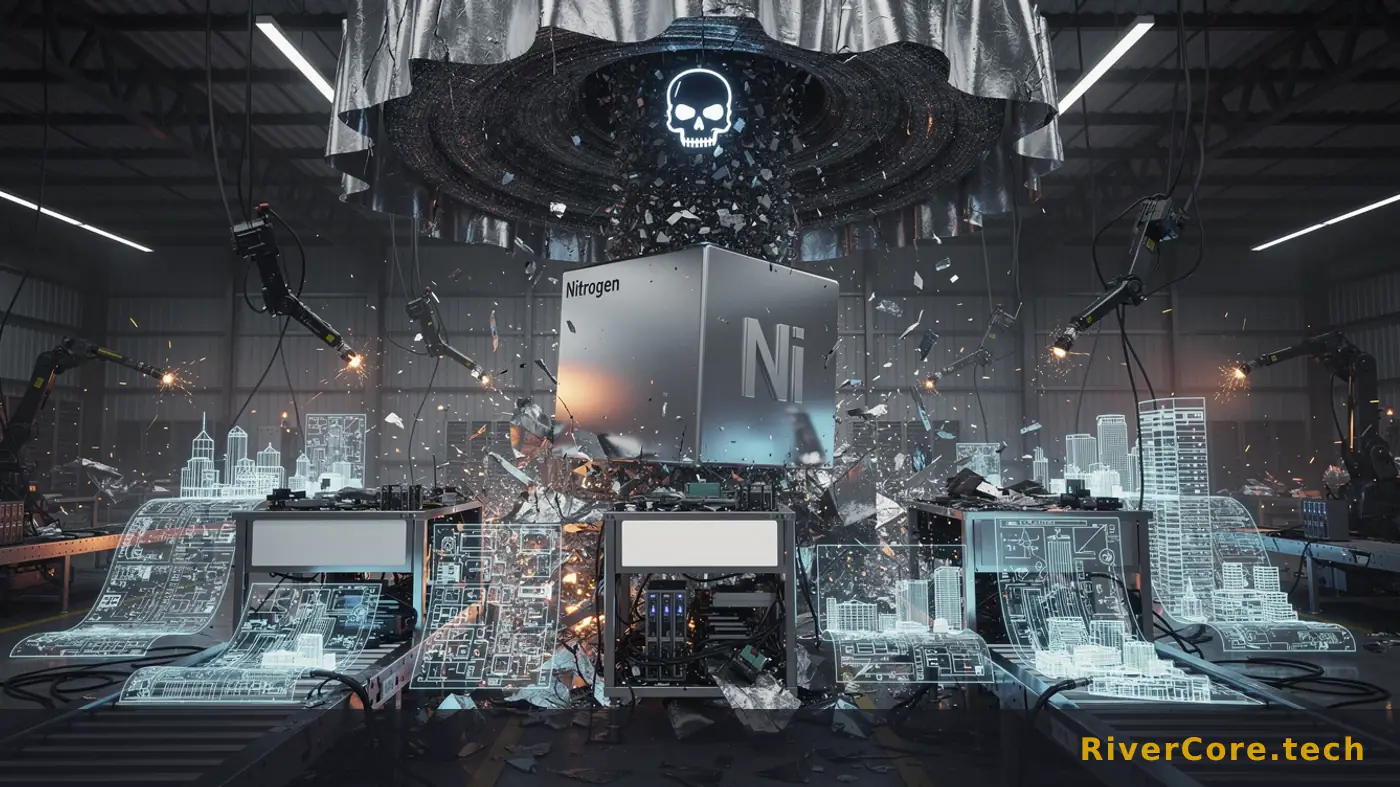
Foxconn Confirms Nitrogen Ransomware Hit on North American Plants
The question every Head of Platform buying contract-manufactured hardware should be asking their GC this week is whether their MSA with Foxconn, or any tier-one EMS partner, contains a breach notification clause that actually triggers when the attacker, not the vendor, announces the incident first. Because that is exactly what happened on Monday. Nitrogen posted Foxconn to its leak portal claiming 8 terabytes of exfiltrated data, and Foxconn acknowledged the cyberattack the next day. The order of operations matters here more than the megabyte count.
For anyone running infrastructure that touches Intel, AMD, Google, or Nvidia silicon, this is not a Foxconn story. It's a third-party-risk story with your customers' data center diagrams allegedly attached.
What Happened
Nitrogen, a ransomware crew active since 2023, listed Foxconn on its breach and extortion portal on Monday, claiming it had pulled more than 11 million files totaling 8TB from Foxconn systems. As CyberSecurityNews reported, Foxconn confirmed the intrusion the following day through a spokesperson statement to The Register: "Some of Foxconn's factories in North America suffered a cyberattack," followed by the usual reassurance that "the cybersecurity team immediately activated the response mechanism and implemented multiple operational measures to ensure the continuity of production and delivery."
The affected sites include Foxconn's Mount Pleasant, Wisconsin plant, which primarily builds televisions and data servers, and a factory in Houston, Texas. Some staff were temporarily sent home or pushed back to pen and paper, which tells you the blast radius hit operational systems, not just back-office file shares. Foxconn says affected facilities are resuming normal production and has declined to confirm whether any customer data was actually stolen.
Nitrogen's claims, however, are specific. The gang says the haul includes confidential instructions, internal project documentation, and technical drawings tied to work for Intel, Apple, Google, Dell, and Nvidia. Sample files publicly released by the group reportedly contain financial documents from the Houston facility, circuit board layouts, temperature sensor data, integrated circuit documentation, and, most damaging, network topology maps for AMD, Intel, and Google projects. AppleInsider's review of the samples found nothing that looks like Apple circuit diagrams, product development docs, or QC data, which lines up with the fact that Mount Pleasant is not an Apple line. This is at least the third major ransomware incident Foxconn has publicly weathered.
Technical Anatomy
Nitrogen is not a novel piece of engineering. It is believed to be built on leaked source code from the Conti 2 builder, with suspected operational links to the ALPHV/BlackCat ecosystem. That lineage matters for two reasons. First, the encryption and exfiltration tooling is mature and well-understood by defenders, which means the initial access vector, not the payload, is where the real failure happened. Second, double-extortion (encrypt and leak) is the entire business model. Refusing to pay does not protect the data, it accelerates publication. The MITRE ATT&CK mapping for Conti-derived families is well-documented: phishing or compromised RDP for initial access, Cobalt Strike or similar for lateral movement, then living-off-the-land tooling to stage exfiltration before the encryptor fires.
The interesting technical detail is what Nitrogen claims to have grabbed. Circuit board layouts and IC documentation are commercially sensitive but not catastrophic. Network topology maps for hyperscaler data center projects are a different category of artifact entirely. As security analyst Mark Henderson put it, "The real concern is that Google and Intel's network topologies have been stolen. Because this is an architectural map of operational infrastructure, attackers could use this data to identify vulnerabilities in data centers around the world."
Translation: if those files are authentic, Nitrogen is not selling ransomware decryption. It's selling reconnaissance to whoever buys next. Topology diagrams compress months of red-team enumeration work into a PDF. They tell an attacker which segments host management planes, where east-west traffic concentrates, and which choke points are worth targeting with a zero-day. That data ages slowly. A 2026 topology leak is still useful in 2028.
The fact that staff reverted to pen and paper also tells us something about the segmentation between IT and OT at these facilities. If a ransomware event in a corporate file environment can stop production-floor activity, the air gap is more aspirational than architectural. That is a recurring story in EMS and one the hyperscaler customers will now be asking pointed questions about.
Who Gets Burned
The obvious losers are Foxconn's named customers. Intel, AMD, Google, Dell, and Nvidia now have to assume, regardless of what authentication work follows, that some subset of their project documentation is in adversary hands. The CISO at each of those firms is spending this week running an internal exercise: which of our contracts with Foxconn cover this scenario, what data was technically in scope to be at that facility, and what is our public posture if Nitrogen drops the full dump?
The less obvious losers are every other EMS and ODM in the tier-one bracket. Jabil, Flex, Wistron, Pegatron, Quanta. Their sales teams are about to spend the next two quarters answering procurement questionnaires that did not exist last month. Expect new contractual demands around segmentation attestation, SOC 2 Type II evidence specific to manufacturing networks, and possibly customer-supplied EDR agents on engineering workstations.
For platform leads at fintech, iGaming, and crypto firms reading this and thinking it's a hardware problem: it isn't. The same pattern applies to any vendor that holds your architectural diagrams. Your cloud cost optimization consultancy. Your pen-test firm's report repository. Your DR runbook in a shared Notion workspace. The Foxconn incident is a reminder that the value of an artifact to an attacker is often inverse to how carefully the holder treats it.
The CFO at any company named in the leak should be asking this week what the disclosure obligations are under their existing cyber insurance policy and whether a third-party breach affecting their IP triggers the same notification timeline as a first-party event. The answer is usually "it depends on the policy language," which is why GCs earn their salary.
Playbook for Security Teams
Three concrete actions for the next ten business days.
First, inventory which vendors hold your network diagrams, infrastructure-as-code repos, or any document that describes the shape of your production environment. Not which vendors have access to production. Which vendors have access to descriptions of production. That list is almost always longer than the security team thinks and almost always under-protected on the vendor side.
Second, rotate any credentials, API keys, or shared secrets that have ever lived in a document shared with a contract manufacturer or large EMS partner, even if you have no direct exposure to Foxconn. Treat this as a forcing function to audit secret hygiene in vendor-shared artifacts. The Conti-lineage tooling Nitrogen runs is exactly the kind of operation that grep's exfiltrated archives for high-entropy strings before the leak post goes live.
Third, pull your IR plan and check whether it accounts for the scenario where a vendor's attacker publishes your data before the vendor tells you. Most plans assume the vendor calls you. Nitrogen's timeline (leak post Monday, vendor confirmation Tuesday) inverts that assumption. Your comms and legal team need a 24-hour playbook for "we found out from a leak site," because that is now the modal scenario for supply-chain ransomware. Map your detection coverage against the relevant ATT&CK techniques for double-extortion crews, particularly the staging and exfiltration phases where defenders still have time to interrupt.
Key Takeaways
- Nitrogen claims 8TB and 11 million files from Foxconn's North American operations, with Foxconn confirming the cyberattack one day after the leak site post went live.
- The most strategically damaging artifacts are alleged network topology maps for AMD, Intel, and Google projects, which retain attacker value for years regardless of ransom outcome.
- Nitrogen is built on Conti 2 leaked source with suspected ALPHV/BlackCat operational links, meaning the payload is commodity and the access vector is where the real failure occurred.
- Production disruption requiring pen-and-paper workarounds at Mount Pleasant and Houston indicates weaker IT/OT segmentation than tier-one EMS marketing materials suggest.
- This is at least Foxconn's third major ransomware incident, and procurement teams across hyperscaler and fintech buyers should expect new vendor security attestation requirements within two quarters.
Frequently Asked Questions
Q: What did the Nitrogen ransomware gang claim to steal from Foxconn?
Nitrogen claims 8 terabytes of data spanning more than 11 million files, including confidential instructions, project documentation, technical drawings, financial records from the Houston facility, circuit board layouts, IC documentation, and network topology maps tied to AMD, Intel, and Google projects. Foxconn has not confirmed whether customer data was actually stolen.
Q: Which Foxconn facilities were affected?
The confirmed affected sites are Foxconn's Mount Pleasant, Wisconsin plant, which primarily manufactures televisions and data servers, and a factory in Houston, Texas. Some staff were temporarily forced to work on pen and paper or stay home during the disruption, and Foxconn says affected facilities are now resuming normal production.
Q: Why are the alleged network topology maps the most serious part of this leak?
Topology maps describe the operational architecture of hyperscaler data center projects, giving attackers a head start on identifying vulnerable segments, management planes, and choke points. As security analyst Mark Henderson noted, this kind of architectural map could be used to identify vulnerabilities in data centers globally, and the intelligence value of such documents does not decay quickly.