
MFG Turns 1,200 UK Forecourts Into a Digital Ad Network
Picture the old Burma-Shave signs from 1930s America: a sequence of little roadside boards that turned a boring drive into a captive five-second ad break. Petrol stations were the original attention merchants, long before anyone bid on a keyword. Motor Fuel Group has just decided it's time to put the band back together, only this time the signs are LCDs and the metadata flows both ways.
What Happened
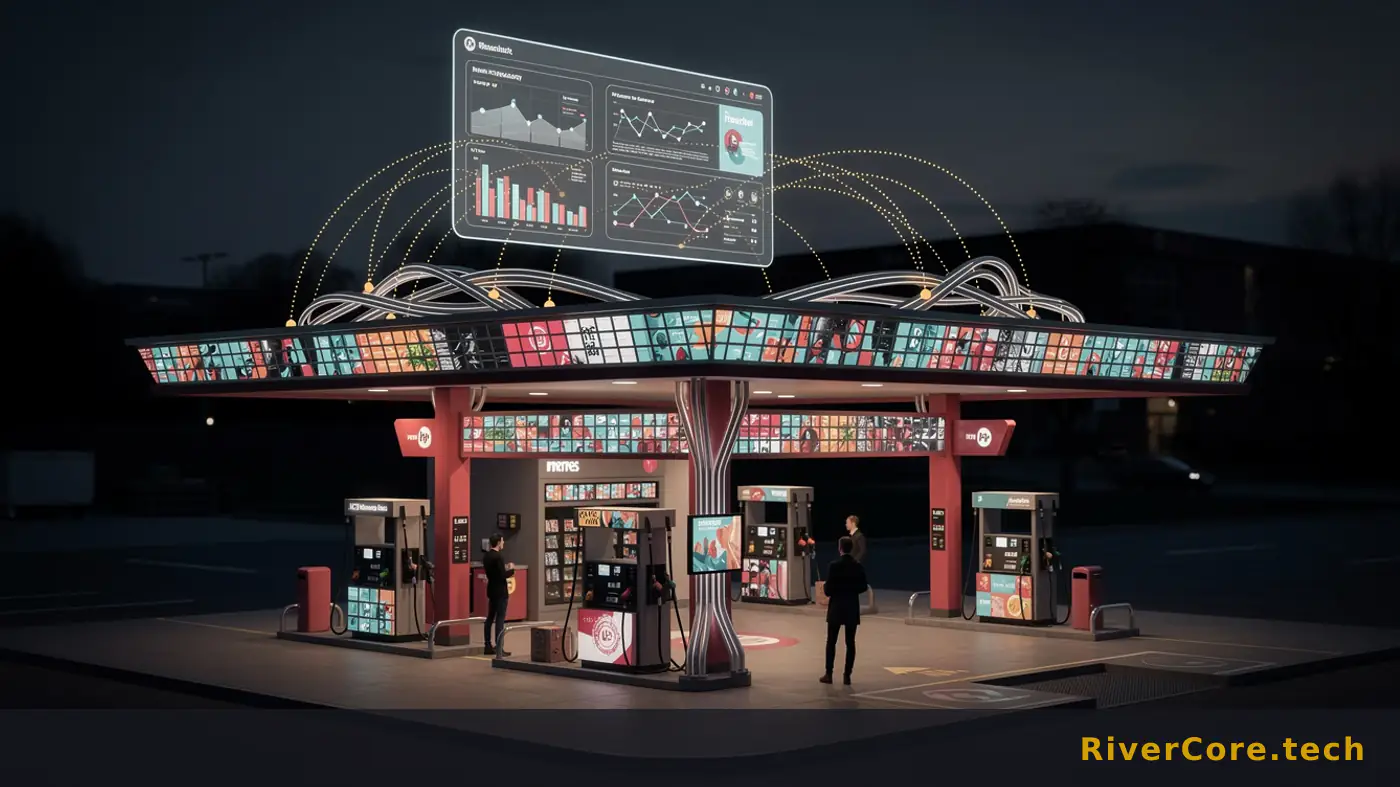
As MobilityPlaza reported, Motor Fuel Group has launched a digital advertising proposition across more than 1,200 UK forecourts, in partnership with retail media specialist GIG Retail. The rollout introduces a multi-screen digital network that spans both the forecourt exterior and the in-store environment.
The format mix is the interesting bit. Outward-facing window screens are positioned to catch roadside traffic, the kind of driver glancing up while waiting for the pump to click off. Inside the shop, displays sit above payment counters and at the cash registers themselves, the dwell-time goldmine where customers are queueing with a meal deal in hand and nowhere else to look.
MFG's estate hosts the Shell, BP and Esso brands, plus a range of retail and food operators. Greggs has piloted an Express self-service format at MFG forecourts. MFG EV Power has rolled out Plug&Charge across the UK network, which matters because an EV driver parked for 20 minutes is a very different audience to a petrol customer in and out in four. The company's own framing leans on the fact that nearly half of UK motorists who buy fuel also buy non-fuel items, which is the entire commercial premise. Forecourts are no longer single-purpose stops. They're EV charging, parcel collection, grocery shopping and food-to-go, all stacked on the same square of tarmac.
The stated ambition is to reach millions of consumers through targeted messaging at what the operator calls "key moments". Translated from press release into engineering: a digital out-of-home (DOOH) network with measurable inventory, dayparting, and presumably some flavour of audience modelling on top.
Technical Anatomy
Anyone who has tried to wire up a DOOH network at scale knows the boring bit is never the screens. The boring bit is content delivery, scheduling, proof-of-play, and the fact that one corner of Aberdeen has 3G that drops out every Tuesday. A 1,200-site network is right at the threshold where naive solutions stop working and you start needing real infrastructure.
The likely architecture is a programmatic DOOH stack sitting behind a media owner SSP, exposing inventory via OpenRTB extensions for DOOH. The IAB Tech Lab spec for OpenRTB has DOOH fields for venue type, screen count and impression multipliers, which is how a single playout on a forecourt window screen gets translated into something a buyer used to web CPMs can actually bid on. If GIG Retail is doing this properly, every screen is a node with a venue taxonomy code, a measured audience curve by hour, and a playout log that gets reconciled back to billing.
Then there's the measurement problem, which is where it all falls over for most retail media networks. You can serve an ad to a window screen, but did the driver in the Vauxhall actually look at it? The honest answer is "we modelled it". Expect computer vision counting at a sample of sites, mobile location SDK panels for reach and frequency, and loyalty-card sales lift studies as the closed-loop attribution play. That last one is the real prize: tying an ad impression at pump 4 to a Monster Energy ring on the till 90 seconds later.
The interior screens above payment counters and at registers are easier territory. Dwell time is high, the audience is captive, and sales lift can be measured at SKU level via the EPOS feed. This is essentially what Tesco's Dunnhumby and Boots Media Group already do indoors, ported to a forecourt context where the customer profile skews differently. EV charging bays add a third audience segment with materially longer dwell, which is a different ad product entirely. A 30-second spot doesn't work on a petrol customer. It works fine on someone tethered to a Plug&Charge session for 18 minutes.
Who Gets Burned
The obvious losers are the static billboard operators on the same arterial roads. A digital window screen with dayparting and creative swap-out eats the lunch of a six-sheet poster that costs the same and refreshes every six weeks. Roadside billboard inventory in the UK has been under pressure for years, and adding 1,200 digital surfaces at the precise moment drivers are stationary is not going to help.
Less obvious: the existing forecourt FMCG trade-marketing budgets. Brands like Red Bull, Cadbury and Walkers have spent decades buying physical end-cap displays and counter units. A lot of that spend is about to get reframed as "retail media" and rebilled at digital CPMs. The trade marketing team and the digital media team inside those FMCG brands have historically not spoken to each other. They're about to be forced into the same meeting room.
Performance marketing teams in iGaming and fintech should be paying attention for a different reason. UK gambling advertising rules restrict where and how you can promote, and forecourt screens facing the street are exactly the kind of inventory that will attract regulator scrutiny. I'd argue the first ASA complaint about a sportsbook ad visible from a school run is a matter of when, not if. Crypto exchanges face the same exposure given the FCA's financial promotions regime. If you're a CMO in either category, the answer is probably "interior screens only, with audience verification", and you need that conversation with GIG Retail before someone less careful runs a creative that triggers a category-wide review.
EV charging network operators are also exposed. MFG EV Power now has an advertising revenue line that pure-play chargepoint operators don't. That changes the unit economics of building chargers next to a shop versus building them in a Tesco car park.
Playbook for Performance Marketing
If you're running paid media for a brand that touches the UK motorist, here's what the next 90 days should look like.
First, ask GIG Retail for the audience taxonomy and the measurement methodology in writing. Specifically: what's the source of the audience numbers, is there a third-party verification partner, and what's the closed-loop sales attribution mechanic. If the answer is vague, treat the inventory as brand awareness only and budget accordingly.
Second, segment the inventory mentally into three products: roadside window (broad reach, short dwell), counter and till (high intent, captive), and EV bay (long dwell, premium audience). They are not the same media buy and should not be priced or measured the same way. Push back on any rate card that treats them as one bundle.
Third, for performance teams used to Google Ads API levels of granularity, calibrate expectations. DOOH measurement is closer to TV than to search. The right benchmark is incremental sales lift on a control-versus-exposed regional split, not last-click ROAS. Set up the test design now, before the first campaign runs, otherwise you'll spend six months arguing with finance about whether it worked.
Fourth, if you're in a regulated category, get legal involved before creative. The geography of a forecourt is more sensitive than a web banner.
Key Takeaways
- MFG and GIG Retail have lit up a digital ad network across 1,200+ UK forecourts, with screens at windows, counters and tills.
- The real engineering challenge is measurement and attribution, not screen rollout. Sales lift via EPOS is the closed-loop play to ask about.
- EV charging dwell time creates a fundamentally different ad product to traditional fuel-pump impressions, and should be priced separately.
- Static roadside billboards and untracked FMCG trade-marketing spend are the first budgets to get cannibalised.
- Regulated categories (gambling, crypto, high-cost credit) should treat outward-facing inventory as legally hot and stick to interior, verified-audience placements.
The Burma-Shave boards eventually disappeared because the interstate highways made everyone drive too fast to read them. The forecourt screen sidesteps that problem neatly by waiting until you've already stopped. Whether the measurement holds up under scrutiny is the question the next 12 months will answer, but as a piece of inventory design, this one is built for the way Britain actually drives.
Frequently Asked Questions
Q: How big is MFG's forecourt network in the UK?
Motor Fuel Group operates more than 1,200 forecourts across the UK, hosting fuel brands including Shell, BP and Esso alongside food and retail operators. That scale is what makes the GIG Retail partnership viable as a national ad network rather than a regional pilot.
Q: What kinds of advertising formats does the new MFG network include?
The network spans outward-facing window screens aimed at roadside traffic, displays above payment counters, and screens at the cash registers themselves. The mix is designed to catch both passing drivers and customers queueing inside the shop.
Q: Why does EV charging matter for forecourt advertising?
MFG EV Power has enabled Plug&Charge across its UK network, which creates a customer segment with much longer dwell time than petrol buyers. Longer dwell supports different ad formats and arguably higher CPMs, making EV bays a distinct inventory product within the same network.

Taboola Buys Dianomi to Lock Down Financial Ad Inventory
Taboola is acquiring Dianomi to feed premium financial inventory into its Realize platform. The real story is vertical consolidation and what it means for performance budgets in 2027.

German Court Holds Meta Liable for Scam Ads: What Changes
A German court just told Meta that algorithmic ad delivery kills the DSA lack-of-knowledge defense. Performance marketers should read this carefully.

ChatGPT Ads Hit $1B Run Rate in 200 Days: The New Walled Garden
ChatGPT Ads hit a $1B annualised run rate in under 200 days while OpenAI quietly blocks image and voice rivals from advertising. The intent layer is being enclosed.