

NVIDIA Turns Into a Cloud Landlord With Revenue-Share GPU Deal
Anyone who has tried to sign a multi-year GPU contract in the last eighteen months knows the joke: the hardware quote is the easy part, financing it is where deals die. NVIDIA's answer, announced July 1, is to stop pretending it is only a hardware vendor and start acting like a cloud landlord. The headline number is a Firmus campus in Batam scaling to 360 megawatts and up to 170,000 GPUs, underwritten by a revenue-share and credit-support structure rather than a straight purchase order.
The Numbers
Start with the physical scale. As NVIDIA Blog reported, Firmus Technologies is building a DSX AI factory campus in Batam, Indonesia, expected to scale to 360 megawatts and support up to 170,000 NVIDIA GPUs. For context, that single site is roughly the power draw of a mid-sized aluminium smelter, dedicated to token generation.
Sharon AI is the other named partner, deploying up to 40,000 NVIDIA Grace Blackwell GB300 GPUs. At publicly discussed GB300 price points, that is a hardware bill north of what most sovereign wealth funds would sign off on in a single tranche. The fact that it is happening under a revenue-share arrangement, rather than a cash-up-front purchase, tells you everything about how capital is flowing in this cycle.
The commercial structure has four moving parts worth naming. AI clouds procure the infrastructure. They sell NVIDIA-powered services to AI-native, enterprise and ISV customers. NVIDIA earns standard product revenue on the silicon. And, critically, NVIDIA also takes a share of the cloud revenue on the supported capacity. The company's own framing calls this a recurring, usage-linked earnings stream.
Translate that into operator language: NVIDIA has just quietly turned itself into a cloud royalty holder on top of being a chip vendor. Every fine-tuning job, every agentic inference call running on this supported capacity now feeds two P&Ls at once. The workloads explicitly in scope are model training, post-training, fine-tuning and high-volume agentic inference. That last one matters. Agentic inference is where token consumption goes non-linear, because a single user prompt can fan out into hundreds of tool calls behind the scenes.
The named demand-side examples are Baseten, Fireworks AI and Together AI. None of them run their own fabs. All of them are burning capacity at a rate that makes traditional colo procurement cycles look prehistoric. Production incidents I've seen at fast-growing inference providers usually trace back to the same root cause: capacity commitments made six months ago against a demand curve that doubled in four. This model is engineered for that mismatch.
What's Actually New
Strip away the press-release gloss and ask what genuinely changed. Three things.
First, NVIDIA is now a counterparty on the financing stack, not just a supplier at the top of it. The credit-support component means the company is putting its balance sheet behind AI cloud operators who would otherwise struggle to raise debt against GPU collateral that depreciates on an eighteen-month curve. Banks have been allergic to lending against Hopper and Blackwell inventory because nobody trusts the residual value model. NVIDIA does, because NVIDIA sets it.
Second, the revenue-share flips the incentive on utilisation. Under a pure sale model, NVIDIA books revenue on shipment and then, frankly, doesn't care whether the GPUs run at 30% or 90% utilisation. Under this model, idle capacity is lost recurring revenue for Santa Clara. Expect NVIDIA's software, scheduling and MIG-slicing roadmap to get much more aggressive about squeezing utilisation, because they now eat their own cooking.
Third, the geographic pattern is different. Batam is not Ashburn. Sharon AI is pitching sovereign compute. This is the chipmaker actively seeding non-hyperscaler regions with brand-aligned capacity, framed as DSX AI factories. That is a direct hedge against the three US hyperscalers, who currently dictate NVIDIA's revenue concentration risk.
My take: the interesting bit isn't the GPU count, it's that NVIDIA has stopped trusting AWS, Azure and GCP to be the sole distribution channel for its most expensive silicon. The company watched what Microsoft did with OpenAI's compute contracts and decided vertical alignment was more valuable than channel neutrality.
What isn't new: the underlying customer pain. Model builders have always wanted faster access to capacity without waiting through site selection, power procurement, construction and hardware bring-up. That is a fifteen-year-old complaint. What is new is the vendor picking up part of the bill to shorten the cycle.
What's Priced In for AI Development
For senior engineers and platform leads, most of the surface-level implications are already baked into 2026 planning. Everyone assumes GB300 capacity keeps arriving. Everyone assumes agentic inference costs dominate the bill by year-end. Everyone assumes regional AI clouds proliferate. If you are running an inference platform on top of providers like the named Baseten, Fireworks or Together tier, this announcement doesn't change your architecture next week.
What is not priced in: the second-order effect on unit economics. If NVIDIA is taking a slice of cloud revenue, that margin has to come from somewhere. Either the AI cloud operator absorbs it, or it gets passed through to the customer as a slightly worse dollar-per-token rate than a non-supported deployment. Teams building cost models that assume commodity GPU pricing on these DSX-aligned factories should stress-test that assumption. The agentic patterns that dominate 2026 workloads, where a single request can trigger long tool-use chains, are exactly the workloads NVIDIA now shares in.
Also underpriced: the credit-support angle changes who can enter the market. A regional operator with a strong power deal and weak balance sheet was previously locked out. Now they aren't. Expect a wave of second-tier AI clouds in Southeast Asia, the Gulf and Latin America over the next four quarters, all pitching sovereign compute with NVIDIA financial scaffolding underneath.
Verdict for platform teams: rebuild your provider matrix. The old distinction between hyperscaler and neocloud is being replaced by NVIDIA-aligned versus not-NVIDIA-aligned. That is the axis that will actually predict capacity availability and pricing behaviour in 2027.
Contrarian View
The consensus read is that this is bullish for AI-native builders because capacity gets cheaper and faster to access. I'm not convinced.
The uncomfortable read: revenue-share models historically consolidate power with the party that owns the scarce input, not the party renting it. NVIDIA owns the scarce input. AI cloud operators signing these deals are trading balance-sheet risk today for margin compression forever. If GB300 successors extend NVIDIA's software moat further, and CUDA lock-in deepens through DSX-aligned tooling, the operator's exit ramp gets narrower every year.
There is a second concern. A 360-megawatt campus in Batam is a physically enormous, single-jurisdiction bet. Teams I've worked with in regulated verticals will have opinions about routing inference for European or US customers through Indonesian sovereign infrastructure. Data residency, export controls on model weights, and cross-border latency all become active engineering problems, not procurement footnotes.
And if the AI inference demand curve flattens even modestly in 2027, NVIDIA still collects product revenue on shipped silicon. The operator, holding a half-utilised campus and a revenue-share obligation, does not. Downside is asymmetric.
Key Takeaways
- NVIDIA is now a revenue-share counterparty on cloud services, not just a chip vendor. Recurring, usage-linked earnings change how the company will push utilisation and software lock-in.
- Sharon AI (up to 40,000 GB300 GPUs) and Firmus (360MW, up to 170,000 GPUs in Batam) are the anchor tenants. Expect more regional operators to sign similar structures within two quarters.
- Agentic inference is explicitly in scope. Cost models built on flat per-token pricing need to account for a vendor taking a slice on supported capacity.
- The credit-support component is the real unlock. It lets operators without hyperscaler balance sheets finance GPU inventory that banks won't touch alone.
- Platform leads should re-segment their provider matrix along DSX-aligned versus independent lines. That distinction will predict 2027 capacity and pricing better than the old hyperscaler-vs-neocloud split.
Frequently Asked Questions
Q: What is NVIDIA's new revenue-sharing model for AI compute?
NVIDIA is enabling AI cloud operators to procure its infrastructure under a revenue-share and credit-support structure. NVIDIA earns standard product revenue on the hardware plus a share of the cloud revenue generated on supported capacity, giving it a recurring, usage-linked earnings stream.
Q: How large are the Sharon AI and Firmus deployments?
Sharon AI is deploying up to 40,000 NVIDIA Grace Blackwell GB300 GPUs. Firmus is building a DSX AI factory campus in Batam, Indonesia, expected to scale to 360 megawatts and support up to 170,000 NVIDIA GPUs.
Q: Which workloads is this new infrastructure model targeting?
The model targets model training, post-training, fine-tuning and high-volume agentic inference. Named examples of the kind of AI-native demand it serves include Baseten, Fireworks AI and Together AI, all of which need immediate access to large-scale accelerated compute as usage scales from pilot to production.

Multi-Model AI Just Became a Platform Problem, Not a Vendor One
Anthropic shipped Opus 5.5, OpenAI shipped GPT-6 Sol and Luna, and Palo Alto Networks quietly admitted no single model catches more than 40% of vulnerabilities.

Gemini 3.8 Live Hits $0.023/Min: Google Undercuts Voice AI Stack
Google shipped Gemini 3.8 Live at $0.005/min input and $0.018/min output, plus a 2.6% WER transcription model. The economics of cascaded voice stacks just got harder to defend.
Four Subscribers Sue Big AI Over Alleged Slowdown Pact
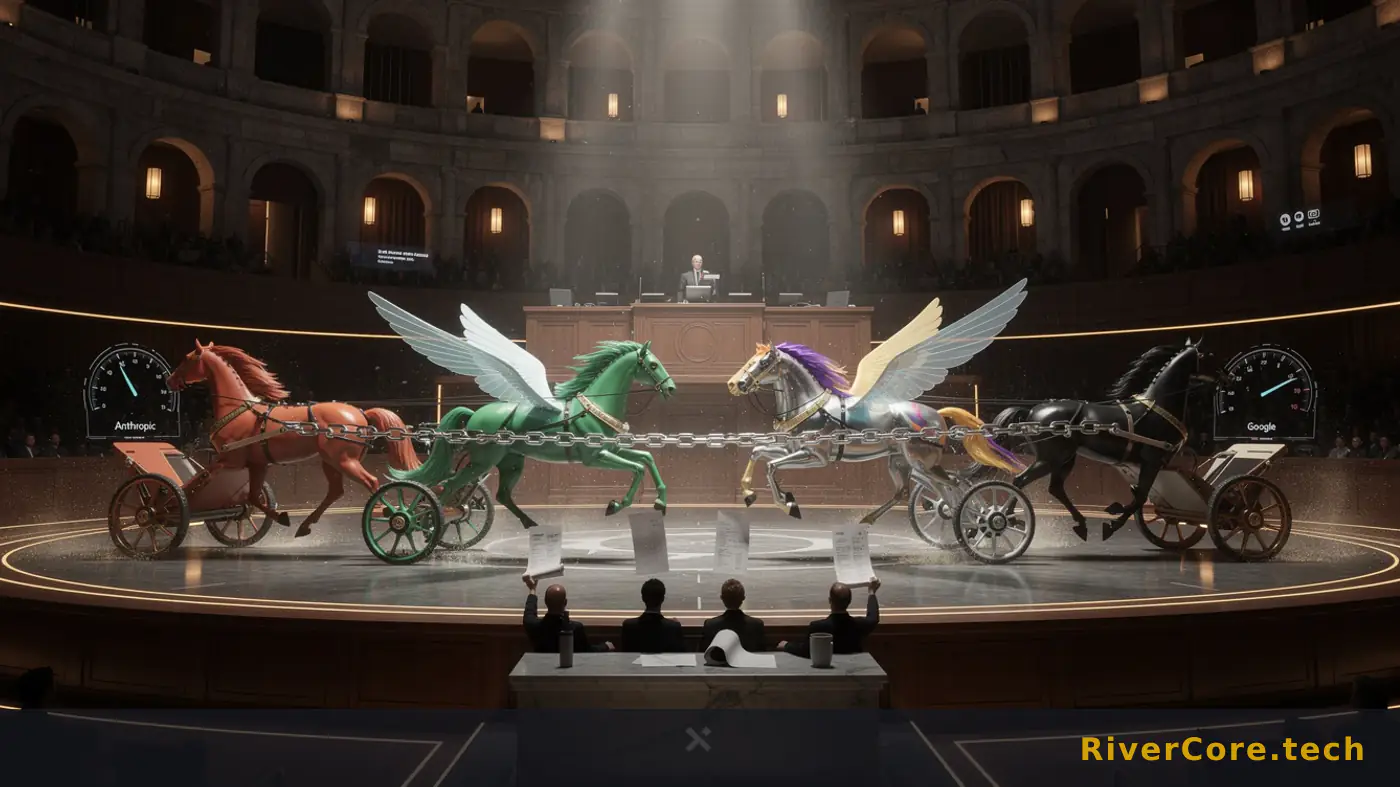
Four chatbot subscribers filed a class action claiming Anthropic, OpenAI, Google and xAI agreed to hold their models back. Section 1 of the Sherman Act meets AI safety.