
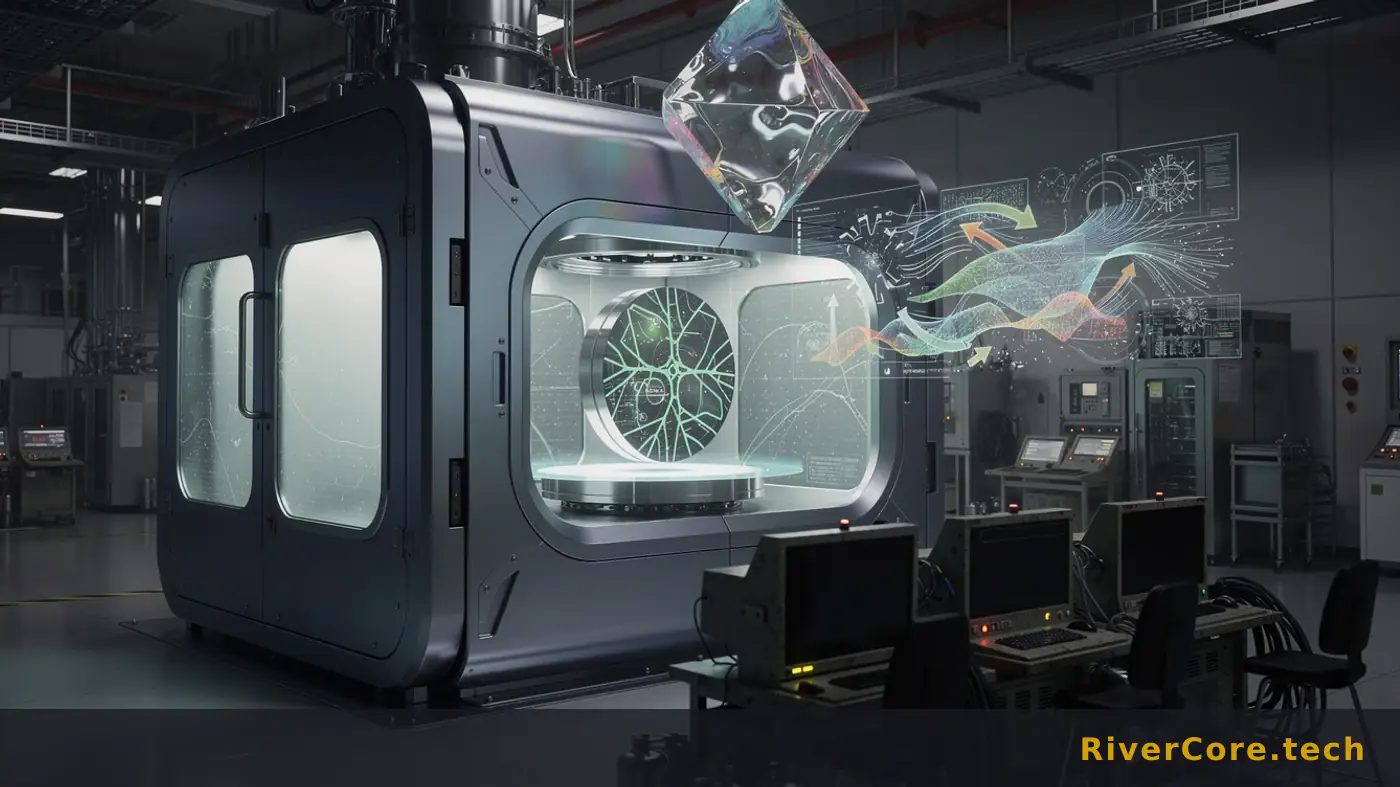
NVIDIA and TSMC Put AI on the Fab Floor
Picture a Formula 1 pit crew where the tyre supplier suddenly walks around to the driver's side of the car and asks for the steering wheel. That's roughly what happened on the last day of May, when NVIDIA and TSMC announced they're embedding AI directly into the fabs that make the chips NVIDIA sells. The supplier is now sitting inside the manufacturer's cockpit.
What Happened
The headline is short and the implications are not. As NVIDIA Newsroom reported on May 31, 2026, NVIDIA and TSMC are collaborating to bring AI into TSMC's semiconductor fabs, with the stated aim of advancing both chip design and manufacturing.
That's the entire factual perimeter of the announcement. No SKU, no agent SDK name in the press line, no dollar figure attached. But anyone who has watched the chip supply chain for the past three years knows what a sentence like that actually means. TSMC fabricates the silicon that NVIDIA designs. The two companies have been locked in the tightest customer-supplier embrace in modern hardware, and now they're formalising a feedback loop between the design side and the manufacturing side.
The pit-crew analogy holds up here. Historically, a fabless designer throws a tape-out over the wall, the foundry runs it through its process, yields come back weeks later, and the designer learns what worked. AI agents collapsing that loop means design decisions can be informed by manufacturing telemetry in something closer to real time, and manufacturing parameters can be tuned with knowledge of what the design actually needs.
For an industry where a single mask set costs more than most Series B rounds, shaving iterations off that cycle is the prize. And NVIDIA, the company that benefits most when TSMC's leading-edge nodes ramp faster, has the strongest possible incentive to put engineers (and now agents) inside that loop.
Technical Anatomy
The boring bit, which is also the interesting bit, is what "AI in the fab" actually touches. Fabs are some of the most heavily instrumented environments humans have ever built. Every tool, every chamber, every wafer carrier emits telemetry. Defect inspection systems generate image data at volumes that would make a hyperscaler blink. The data has always been there. The constraint has been turning it into decisions fast enough to matter.
Agentic AI changes the shape of that problem. Instead of dashboards a process engineer reads, you get agents that watch the telemetry stream, correlate excursions across tools, and propose interventions. Think of the difference between a security analyst grepping logs and a SIEM that actually fires playbooks. The fab equivalent is an agent noticing that a particular etch chamber is drifting in a way that historically preceded yield loss on a specific layer of a specific product, and flagging it before the next lot starts.
On the design side, the same approach is well-trodden territory for NVIDIA. The company has been talking about AI-assisted EDA for years, and the agentic patterns that have matured in software (tool use, planning, multi-step execution as documented in Anthropic's docs) map onto chip design surprisingly well. Place-and-route, timing closure, DRC fixing: all of these are search problems over enormous state spaces where a competent agent with the right tools can outwork a tired human at 2am.
The genuinely new piece is the bridge. Design agents that know what the fab is currently good at, and fab agents that know what the design is trying to do, can negotiate. A timing-critical path that would normally demand a tighter pitch could instead get routed around a region the fab is currently yielding poorly on. That's not science fiction, it's just data plumbing plus inference, and both companies have the inputs.
The part where it all falls over, of course, is trust. Fabs don't change recipes on the say-so of a probabilistic model. Any agent operating in this environment has to produce auditable, reproducible recommendations, and the humans stay in the loop for anything that touches a live process. Whatever ships here will look a lot more like Copilot than autopilot.
Who Gets Burned
Start with the other foundries. Samsung Foundry and Intel Foundry Services were already chasing TSMC on process technology. Now they're chasing TSMC plus a deeply integrated AI co-design partner whose chips happen to be the most coveted accelerators on Earth. That's a hard gap to close with marketing.
The EDA incumbents should be reading the announcement twice. Synopsys, Cadence, and Siemens EDA have been racing to bolt agentic features onto their tool stacks. A direct NVIDIA-TSMC collaboration risks turning their tools into the substrate rather than the value layer. If the interesting optimisation work moves into agents that talk directly between designer and fab, the EDA vendors become the API, not the application.
Fabless competitors of NVIDIA are in an awkward spot too. Every AMD, every Broadcom, every hyperscaler designing custom silicon at TSMC now has to ask whether their largest competitor is getting preferential telemetry, faster iteration loops, or earlier access to process knowledge. TSMC will insist on Chinese walls. Customers will insist on more than insistence.
For AI infrastructure teams further down the stack, the next 90 days are mostly about reading the runes. Anyone building on top of NVIDIA hardware, whether that's training clusters for foundation models or inference fleets for fintech and iGaming workloads, should expect the cadence of new silicon to keep accelerating. Capacity planning that assumed a tidy two-year refresh cycle is going to look quaint.
And there's a subtler burn for the agent-tooling startups. NVIDIA has effectively announced a flagship reference deployment of physical-AI agents in one of the most demanding industrial environments in the world. Anyone pitching "agentic AI for manufacturing" to a board next quarter is now competing with a case study involving the most valuable company in semiconductors and the most valuable foundry in history.
Playbook for AI Development
If you're leading an AI platform team, this announcement is a useful forcing function. A few concrete moves worth making this week.
First, audit where your own agentic systems sit on the autonomy spectrum. The NVIDIA-TSMC pattern, agents that observe, propose, and require human approval for high-stakes actions, is the only pattern that survives contact with regulated or high-cost environments. If your roadmap has agents writing to production without a human in the loop, the bar for evals just got higher because your board members read press releases too.
Second, get serious about tool-use protocols. Whether you're building on OpenAI's platform, Anthropic, or open-weight models via Hugging Face, the agents that ship to production in 2026 are the ones with disciplined tool interfaces, structured outputs, and replayable traces. The fab people aren't going to accept "the model said so" and neither should your CFO.
Third, for engineering leaders in fintech and iGaming specifically: physical-AI patterns translate. A fraud-detection agent watching transaction telemetry has more in common with a fab-floor agent watching defect data than most people realise. Same shape of problem, same need for auditability, same intolerance for hallucination. Steal the patterns.
Finally, refresh your hardware assumptions. If NVIDIA and TSMC are compressing their iteration loop, expect more frequent, more specialised accelerators. Lock in flexibility in your inference stack now, before the next generation lands and your carefully tuned kernels become obsolete.
Key Takeaways
- NVIDIA and TSMC announced on May 31, 2026 that they're bringing AI into TSMC fabs to advance both semiconductor design and manufacturing.
- The real prize is collapsing the design-to-manufacture feedback loop, where agents can close the gap between what a designer wants and what the fab can currently deliver.
- Rival foundries and EDA incumbents face the sharpest squeeze, with the supplier increasingly sitting inside the customer's cockpit.
- Fabless competitors of NVIDIA will demand hard guarantees that telemetry and process knowledge don't leak through the collaboration.
- For AI platform leaders elsewhere, the pattern to copy is human-in-the-loop agents with disciplined tool use and replayable traces, not autonomous decision-makers.
Back to the pit crew. The tyre supplier holding the steering wheel only works if everyone in the garage trusts that the data flows one way and the decisions stay where they belong. NVIDIA and TSMC are betting they can build that trust at the speed of silicon. The rest of the grid is going to have to decide, fast, whether to copy the move or get lapped.
Frequently Asked Questions
Q: What did NVIDIA and TSMC actually announce?
On May 31, 2026, NVIDIA and TSMC announced a collaboration to bring AI into TSMC's semiconductor fabs, with the goal of advancing both chip design and manufacturing. The announcement was light on product specifics but signals a deep integration between the designer and the foundry.
Q: Why does AI in a semiconductor fab matter for AI developers outside chipmaking?
Faster iteration in the fab means faster cadence on new accelerators, which changes capacity planning and refresh assumptions for anyone running large training or inference workloads. The agentic patterns being deployed (observe, propose, require human approval) are also a useful template for AI in other high-stakes environments.
Q: Does this hurt EDA vendors like Synopsys and Cadence?
It puts pressure on them. If meaningful optimisation work moves into agents that talk directly between NVIDIA's designers and TSMC's fabs, EDA tools risk becoming infrastructure rather than the layer where value is captured. Expect the incumbents to respond with their own agentic offerings quickly.

Multi-Model AI Just Became a Platform Problem, Not a Vendor One
Anthropic shipped Opus 5.5, OpenAI shipped GPT-6 Sol and Luna, and Palo Alto Networks quietly admitted no single model catches more than 40% of vulnerabilities.
Gemini 3.8 Live Hits $0.023/Min: Google Undercuts Voice AI Stack
Google shipped Gemini 3.8 Live at $0.005/min input and $0.018/min output, plus a 2.6% WER transcription model. The economics of cascaded voice stacks just got harder to defend.

Four Subscribers Sue Big AI Over Alleged Slowdown Pact
Four chatbot subscribers filed a class action claiming Anthropic, OpenAI, Google and xAI agreed to hold their models back. Section 1 of the Sherman Act meets AI safety.