Riot Signs $9B Anthropic Deal as Miners Become AI Landlords
Every gold rush ends the same way. The prospectors go broke, the shovel sellers get rich, and eventually somebody figures out the real money was in owning the river the miners drank from. Riot Platforms just sold twenty years of river access to Anthropic for $9.1 billion, and the market cheered for about an hour before remembering it wasn't sure what it had just witnessed.
The headline number is enormous. The reaction was stranger. And the implications for how public markets value the entire crypto mining sector are, in my view, larger than the deal itself.
The Numbers
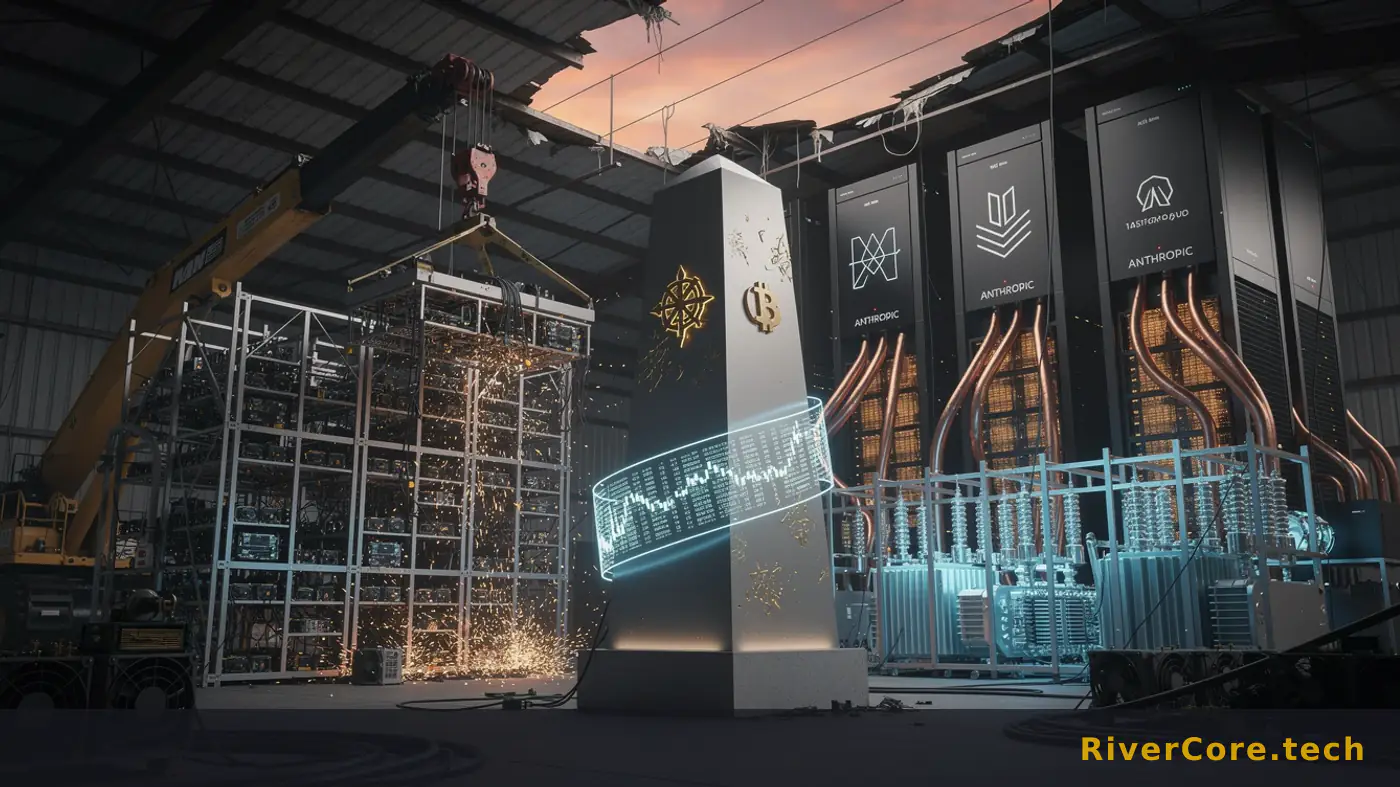
Here's the guts of it. Riot has struck a compute deal with Anthropic worth $9 billion over 20 years, expected to generate $9.1 billion in revenue over that term, as CNBC reported after David Faber confirmed the agreement. If Anthropic exercises two additional five-year extensions, the total climbs to roughly $16.1 billion.
The physical asset being sold is 191 megawatts at Riot's Rockdale, Texas campus. That is grid-connected power, which is the whole point. Anyone who has tried to stand up a training cluster in the last eighteen months knows the bottleneck is not chips or capital, it's a substation and an ERCOT interconnect that already exists.
Stack the Anthropic contract on top of Riot's existing deal with AMD and Compass Point analyst Michael Donovan now describes Rockdale as a "two-tenant campus carrying $9.8 billion of contracted data center revenue." Donovan reiterated a Buy rating and held his $29 price target. A bitcoin miner is being underwritten on the basis of contracted lease revenue, which is roughly what happens when a mining stock quietly becomes a data center REIT wearing a hoodie.
The market reaction is the interesting bit. Shares initially soared more than 20%, then gave up almost the entire gain. That is not the tape of a market discovering hidden value. That is the tape of a market repricing what Riot actually is, then realising it doesn't yet know how to value the new thing.
Twenty years is a long lease. For context, the Bitcoin halving cycle, which sets the entire cost curve of the mining business, runs quadrennially. Riot has just signed a contract that will outlast five halvings. Whatever you think bitcoin's price will do between now and 2046, it barely matters for this campus.
What's Actually New
The miner-to-AI pivot began taking shape in 2022 during the last crypto slump. Back then it was smaller operators, the ones already underwater when spot price dropped below all-in cost of production. Cipher Mining, Hut 8 and Terawulf are now grouped as hybrid miners, running both hash and HPC tenants under the same roof. Riot, Mara Holdings and CleanSpark had largely stayed pure-play miners.
Riot just stopped being pure-play. That is the signal.
What's different about this cycle is not that miners are pivoting, it's who is pivoting and on what terms. In 2022 the pivot looked like desperation: struggling operators renting spare capacity to whoever would take it, at whatever rate covered the electric bill. In 2026 the pivot looks like a 20-year hyperscaler-grade lease with one of the two or three most valuable private AI labs on the planet.
The second thing that's new is the scarcity framing. Donovan's note flagged that ERCOT is scrutinising new power projects. His argument, and I think he's right, is that increased ERCOT scrutiny slows speculative projects still in the interconnect queue but does nothing to reduce tenant demand. "If anything," he wrote, "the scarcity of greenlit capacity should increase its strategic value." Already-energised sites become moats. Anyone who has waited on an ERCOT queue position knows why a substation with paperwork and a live feed is worth more than any greenfield promise.
The third thing that's new, and this is where I'd argue investors haven't caught up, is tenant credit quality. An AMD contract and an Anthropic contract sitting on the same campus is not a mining business dabbling in colocation. That is a data center operator with two anchor tenants of very different risk profiles, and it should be discounted like one. The problem is Riot still trades in a peer group with Mara and CleanSpark, both of whom remain pure-play miners with cash flows that swing on bitcoin spot.
What's Priced In for Crypto and DeFi
Two things are already priced in. First, that public miners are increasingly valued as digital infrastructure owners rather than bitcoin producers. That thesis has been circulating for two years. If you follow the sector you've heard it a hundred times. Second, that AI compute demand is power-constrained, not chip-constrained. Also consensus.
What is not yet priced in, and I think this is the interesting part for anyone building or investing across crypto infrastructure, is the tenant diversification premium. Riot's rally faded not because the deal is bad, but because the market doesn't yet have a comp. Is this an infrastructure REIT? A specialty colocation provider? A hybrid whose remaining hash business drags a premium multiple back to earth? Nobody quite knows, so the tape defaults to the old mining comp and prints back to flat.
For DeFi and on-chain protocols, the second-order effect is more subtle. If the highest-quality mining hosts are steadily selling their best megawatts on 20-year AI leases, hashrate growth gets constrained by the marginal, less attractive power site. That is arguably bullish for bitcoin miners who choose to stay pure-play, because their contribution to network hashrate becomes more valuable per unit. It's also a slow-motion migration of talent, capex and executive attention away from proof-of-work economics and toward hyperscaler contract law. I don't think that trade has been made yet in most crypto-native portfolios.
Contrarian View
The bull case sells itself. Here is the boring bit that could go wrong.
A 20-year lease is only as good as the counterparty and the escalators. Anthropic is a private company burning cash to train frontier models in a market where the number of viable frontier labs may consolidate. If the AI capex cycle turns before Riot has amortised its build-out, the residual value of a purpose-built cluster is not the same as the residual value of a warehouse. Custom cooling, custom power topology and tenant-specific fit-out don't re-tenant cleanly.
There is also the ERCOT question in reverse. Scrutiny that raises the value of existing capacity today can become political pressure tomorrow. Texas has spent two years watching data center load forecasts grow faster than anyone modelled. If retail electricity prices spike in a hot summer while AI campuses run flat out, the regulatory posture toward large tenants can shift quickly. The part where it all falls over, historically, is when infrastructure winners become political targets.
My take: the deal is genuinely good, the price action is warning that the market's valuation framework is broken, and the risk sitting quietly on the balance sheet is concentration in two customers over a very long horizon.
Key Takeaways
- Riot's $9.1 billion Anthropic deal plus its existing AMD contract puts $9.8 billion of contracted data center revenue on a single Rockdale campus, moving the company decisively out of pure-play mining.
- The 20% rally that fully retraced is the tell: the market knows the deal is large but has no clean comp for a bitcoin miner priced as a two-tenant hyperscale colocation host.
- Grid-connected, ERCOT-energised power is the actual scarce asset. Donovan's point that regulatory scrutiny raises the strategic value of already-approved capacity is the framing to watch.
- Pure-play miners still standing (Mara, CleanSpark) inherit a structurally tighter hashrate growth environment as the best hosts sell megawatts to AI tenants on 20-year terms.
- The under-priced risk is tenant concentration and purpose-built residual value over a horizon that outlasts five bitcoin halvings. Long leases cut both ways.
Back to the river. Riot didn't stop being a miner because it lost faith in the gold. It stopped being a miner because it figured out that the water rights it accidentally accumulated over a decade of hashing are worth more to Anthropic than they'll ever be worth to a SHA-256 machine. The rest of the sector will notice. Some will follow, some can't, and the ones that can't are about to find out what pure-play really means when the shovel sellers have moved upstream.
Frequently Asked Questions
Q: Why did Riot's stock give back a 20% gain after announcing the Anthropic deal?
The rally faded because public markets don't yet have a clear valuation framework for a bitcoin miner that also carries $9.8 billion of contracted data center revenue across two tenants. Investors default to the mining peer group comparison, which drags the multiple back down. Expect that framework to evolve over the next few quarters as analysts model Riot more like an infrastructure host.
Q: Does this deal mean Riot is exiting bitcoin mining entirely?
Not directly. The 191 megawatts leased to Anthropic at Rockdale is a specific slice of Riot's capacity, and the company has publicly remained in the pure-play mining camp alongside Mara Holdings and CleanSpark. That said, layering a 20-year AI lease on top of the existing AMD agreement signals a strategic shift toward infrastructure hosting as a primary revenue line.
Q: How does ERCOT's scrutiny of new power projects affect the deal's value?
Compass Point analyst Michael Donovan argued that ERCOT's tighter posture slows speculative projects still in the interconnect queue but doesn't reduce tenant demand for large blocks of near-term power. That makes already-energised, grid-connected sites like Rockdale more strategically valuable, which underpins his reiterated Buy rating and $29 price target on Riot shares.