
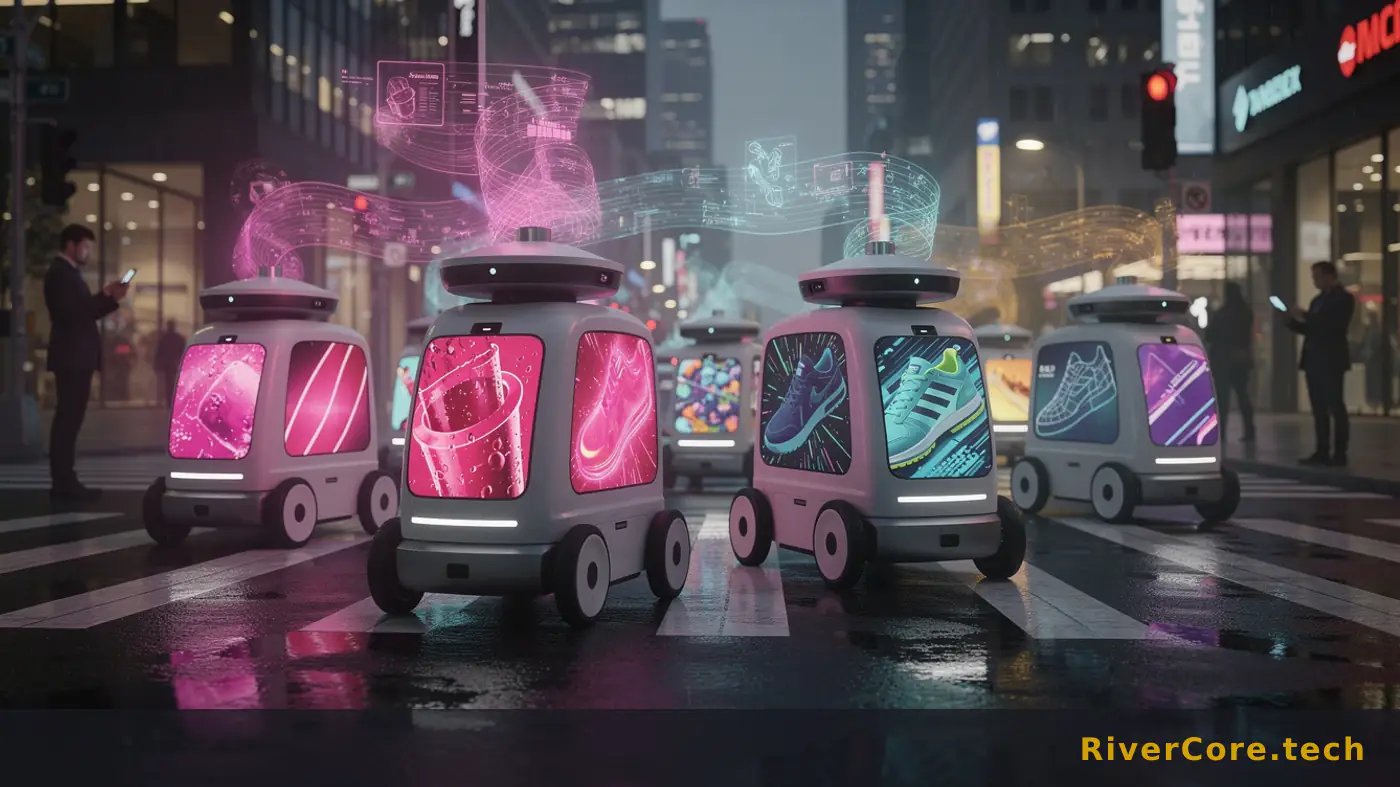
Robot.com Launches R-ads, Turns Delivery Bots Into Billboards
Think of the old ice cream van rolling slowly through a suburb in July, jingle blaring, kids materialising from gardens. The van wasn't a billboard and it wasn't a shop. It was both, and it moved towards demand instead of waiting for it. Robot.com just productised that idea with silicon, screens, and an attribution stack.
The pitch lands at an awkward moment for out-of-home advertising, a category that has spent a decade trying to convince performance marketers it can measure anything beyond a postcode. R-ads says the answer was never better cameras on static signs. It was putting the sign on wheels.
What Happened
Robot.com announced the launch of its next-generation R-ads platform, billed as a smart advertising suite that turns autonomous robots into a measurable, scalable out-of-home media network. As Robotics & Automation News reported, the launch follows more than 100 brand activations across 20+ countries, spanning sports leagues, global tech conferences, CPG launches, and one of the most-watched sporting events in the world.
The fleet underneath this is not vaporware. More than 500 robots are currently deployed across campuses, warehouses, and city streets, and the company says 5 million tasks have been completed to date. Each robot, in other words, was earning its keep doing logistics work before anyone slapped a CPG campaign on its flank.
The most recent proof point is a collaboration with the Ad Council's Heatstroke Prevention campaign, a 15-day activation in Miami timed to the city's largest motorsport event of the year and National Heatstroke Prevention Day on May 1. Venue rules at the event prohibited physical wraps, so the campaign ran entirely through R-ads' integrated digital displays. Robot.com claims it was the first time autonomous robots distributed PSA content at scale at a global motorsport event, generating 147,000+ impressions in the first four days across 50+ miles of robot coverage.
Co-founder and president of robotic media Judah Longgrear summed up the wedge: "Billboards build reach. Robots build interaction. Put them on the same platform, and every impression becomes a result a brand can measure." CEO Felipe Chavez framed the economics: "R-ads is what happens when a robot does more than one job. It delivers, it advertises, it gathers data, and it pays for itself along the way."
Technical Anatomy
The guts of R-ads is a unified, self-serve advertising suite that places campaigns across three formats: moving robots (RDOOH), vehicle wraps (MOOH), and digital screens (DOOH). RDOOH is the new acronym here, and it's doing a lot of work. The boring bit, but the important bit, is the inventory model. A static billboard is a fixed impression-per-hour pipe. A robot is a route, and a route can be priced, optimised, and re-targeted in software.
Each robot is kitted out with integrated screens, QR-enabled engagement layers, and a built-in data-capture system. That last phrase is where the ad-tech reader should slow down. QR scans, dwell time near the robot, and physical sample handoffs are first-party signals tied to a specific geofenced moment. That is a meaningfully different telemetry shape from a DOOH panel that estimates eyeballs from mobile carrier data.
Campaigns that previously took weeks can now launch in minutes, with real-time, AI-powered impression tracking, audience demographics, and attribution analytics. Anyone who has ever tried to reconcile a DOOH measurement report against a digital campaign in the same media plan knows the pain of comparing apples to a vague rumour of apples. R-ads is trying to make the physical leg behave more like the digital leg.
The structural trick is dual revenue per unit. Every robot in the fleet generates revenue from two sources: its primary function (delivery, logistics, inspection) and advertising. That changes unit economics in a way that matters more than any single campaign metric. A delivery robot that also sells media has a lower payback period, which means more robots get deployed, which means more inventory, which means lower CPMs, which means more advertisers. It's a flywheel that static OOH cannot replicate because a billboard does exactly one job.
Worth noting against the IAB Tech Lab backdrop: nothing here is yet standardised. RDOOH does not have a settled measurement spec, and that is going to become a fight.
Who Gets Burned
Static DOOH vendors are the obvious losers, but I'd argue they have a longer runway than the headlines suggest. Times Square is not getting torn down because a robot rolled past it. The real squeeze is on the mid-tier DOOH networks, the ones selling impressions in transit hubs and shopping centres on weak measurement, because R-ads competes for the exact same brand budget with better attribution and a sample-in-hand finale.
Experiential agencies are next in the firing line. The Miami activation is the tell. A 15-day deployment, venue rules that blocked physical wraps, 50+ miles of coverage, and 147,000+ impressions in four days. That is a job an experiential shop used to scope across three months with a team of street-team coordinators and a fleet of vans. Robot.com just compressed that workflow into a self-serve dashboard.
CPG sampling programmes are the most interesting collision. Sampling has always been the rawest form of attention buying: a sachet in someone's hand beats a banner ad on metrics that matter. But sampling has historically been a black box, full of clipboard estimates and trust-me-bro reach numbers. Robots with built-in data capture make sampling measurable in a way it has never been. CPG performance teams who currently route budget through retail trade marketing should be asking why.
The 90-day picture for affected vendors is grim but predictable. Pitch decks will start to add "robotics-ready" slides. Measurement partners will rush to publish whitepapers about why their methodology already covers RDOOH. Expect at least one major DOOH network to announce a partnership with a robotics fleet operator before the end of Q3, because the cheapest move is always to ally with the disruptor before it eats your lunch directly.
Playbook for Performance Marketing
For performance marketers with a physical-world brief, three actions for the next two weeks.
First, run a small RDOOH test with a tight attribution loop. Don't buy reach. Buy a measurable outcome: QR scans to a landing page with UTM parameters, sample redemption codes, or a geo-fenced footfall lift study. The point is to benchmark the channel against your existing paid social and DOOH numbers under the same attribution model you already trust. If R-ads' first-party telemetry maps cleanly into your Google Ads conversion stack via offline conversions, you have a new channel. If it doesn't, you have a measurement integration project.
Second, audit your venue-restricted campaign plans. The Miami case where physical wraps were banned and the campaign ran on digital screens alone is the canary in the coal mine. Major sports venues, conferences, and city centres are tightening rules on physical activations every year. A campaign architecture that can fall back to digital-only without losing measurement is now a planning requirement, not a nice-to-have.
Third, push your media agency to break out RDOOH as a line item in 2026 plans. If they shrug, that tells you everything about whether they are serious about the physical-digital convergence. The category exists now. Treating it as "OOH, miscellaneous" leaves money on the table and hides performance signal in a bucket that nobody benchmarks.
Key Takeaways
- Robot.com's R-ads turns its 500+ deployed robots into a unified ad platform across RDOOH, MOOH, and DOOH, with self-serve campaign launch in minutes.
- The Miami Heatstroke Prevention activation hit 147,000+ impressions in four days across 50+ miles, running on integrated digital displays alone after venue rules blocked physical wraps.
- Dual revenue per robot (primary function plus advertising) is the structural advantage. It subsidises fleet deployment in a way static OOH and pure-play robotics rivals cannot match.
- First-party telemetry via QR layers and built-in data capture closes the measurement gap that has held back OOH from performance budgets for a decade.
- Mid-tier DOOH networks, experiential agencies, and clipboard-driven CPG sampling programmes are the most exposed over the next two quarters.
Back to that ice cream van. It worked because it went to where attention already was, and it left something in the customer's hand. R-ads is the same instinct wrapped in attribution analytics and a fleet API. The part where it all falls over will be measurement standards, and that fight has not started yet. But the wheels are already turning.
Frequently Asked Questions
Q: What is RDOOH and how is it different from DOOH?
RDOOH stands for robotic digital out-of-home, where the ad-carrying surface is a moving autonomous robot rather than a fixed panel. Unlike traditional DOOH, RDOOH inventory is route-based, can react to crowds in real time, and captures first-party engagement signals through QR codes and sampling interactions.
Q: How does R-ads measure campaign performance?
Each robot is equipped with integrated screens, QR-enabled engagement layers, and a built-in data-capture system. R-ads provides real-time AI-powered impression tracking, audience demographics, and attribution analytics through a self-serve dashboard, with campaigns launchable in minutes.
Q: Why does Robot.com's dual-revenue model matter for the robotics industry?
Every robot earns from both its primary function (delivery, logistics, inspection) and advertising. According to CEO Felipe Chavez, that combination lets the unit pay for itself faster, lowering deployment costs and making robotics economically viable in more locations than a single-purpose fleet would allow.
Google Ads API Now Demands Passkeys for New Refresh Tokens
Google's August 5 passkey mandate for new Google Ads API refresh tokens breaks silent-onboarding flows and adds a seven-day trust window agencies must plan around.
Meta Ads Get Pricier in India as CPMs Climb 15-20%
Meta ad prices in India are up 15-20% year-on-year while the pool of actual online shoppers barely grew. The auction is eating D2C margins.
Taboola Buys Dianomi to Lock Down Financial Ad Inventory
Taboola is acquiring Dianomi to feed premium financial inventory into its Realize platform. The real story is vertical consolidation and what it means for performance budgets in 2027.