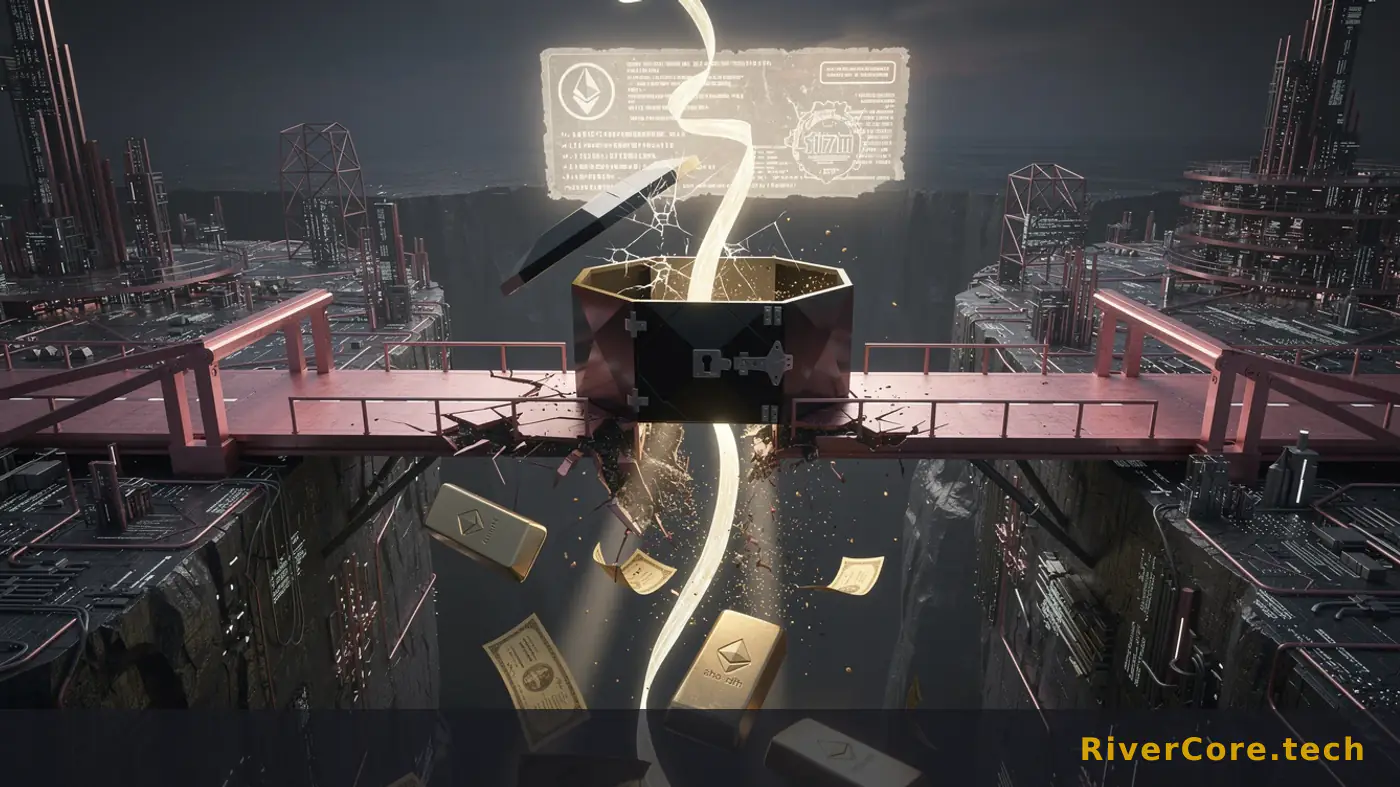
Taiko Bridge Drained for $1.7M After SGX Key Leaks to GitHub
A medieval city had two ways to fall: someone breached the walls, or someone with a key let the wrong people through the side gate. Taiko's bridge exploit on Monday morning was the second kind. The walls held, the cryptography held, the verifier did exactly what it was told. The problem was who got to do the telling.
By breakfast in Dublin, block production was halted and the TAIKO token was down more than 20%. By lunchtime, the postmortem was already pointing at a side gate left wide open on GitHub.
What Happened
On Monday June 22, 2026, attackers drained roughly $1.7 million from the bridge connecting Taiko's Ethereum layer-2 to mainnet, as CoinDesk reported. The attacker forged cross-chain withdrawal proofs, so fake withdrawal requests were accepted on Ethereum without any matching deposit on Taiko's chain. Funds left both the main bridge and the token vault before anyone slammed the door.
The team did move quickly, in fairness. Block producers were instructed to stop minting new blocks. Centralized exchanges were asked to suspend TAIKO deposits. Users were told to withdraw from every bridge on the network. By about 2 a.m. ET, Taiko said the exploit had been contained and withdrawals through the main bridge and token vault were halted.
It wasn't quite fast enough to catch everything. The exploiter had already shifted about 2 million TAIKO, worth roughly $170,000 at the time, into an account on MEXC. TAIKO's market cap, sitting at just $14.5 million before any of this, took a 20%-plus haircut by midnight UTC and kept bleeding.
Security firm BlockSec, posting from its @Phalcon_xyz account, said losses exceeded $1.7M and that its initial investigation pointed at a Raiko SGX enclave signing key left exposed on GitHub. Raiko is Taiko's multi-prover stack for Taiko and Ethereum blocks, the piece responsible for producing the proofs that say "yes, this withdrawal is real." Taiko, which launched on Ethereum in May 2024, has said a full incident report is coming.
Technical Anatomy
Here's the guts of it. Modern L2 bridges work on a trust-but-verify model. When you withdraw from an L2 back to Ethereum, the L1 contract doesn't replay your L2 transaction. It checks a proof, signed by something the L1 trusts, that says the withdrawal really happened on the other side.
Taiko's Raiko stack uses Intel SGX enclaves to produce those proofs. The premise of SGX is straightforward: code runs inside a sealed hardware enclave, the signing key never leaves the enclave, and what comes out is a cryptographic attestation that says "a legitimate prover signed this." It's a clever bit of engineering when it works, and it underpins a lot of optimistic and hybrid rollup designs.
The whole model rests on a single brittle assumption: the signing key actually stays in the hardware. According to BlockSec's read of the evidence, a Raiko SGX enclave signing key ended up publicly accessible on GitHub. Once that key is out, the enclave is just theatre. Attackers can enrol their own provers as legitimate, sign whatever proofs they like, and the L1 verifier nods along because the signatures check out.
That's exactly the shape of what happened. Fake withdrawal requests, no matching deposits, valid-looking proofs, real ETH and tokens leaving the bridge contract. The verifier did its job perfectly. It was given a fraudulent answer key by something it was told to trust.
Anyone who has run hardware-rooted infrastructure in production knows the boring bit: key custody is harder than cryptography. You can ship the fanciest zk or TEE-backed prover in the world, but if a developer commits a debug key, or a CI runner caches one, or a Dockerfile bakes one into a layer, the math doesn't save you. The part where it all falls over is almost always operational, not mathematical.
Who Gets Burned
Taiko itself is the obvious casualty. A $14.5 million market cap project absorbing a 20%+ token drop and an emergency network halt is in survival mode now, not roadmap mode. The next 90 days will be about a credible incident report, a key rotation that users actually believe in, and convincing centralized exchanges to turn TAIKO deposits back on. None of that is quick.
The wider blast radius is more interesting. Bridges have produced more than $340 million in losses across at least 14 exploits in 2026, making them the costliest target in crypto this year. Forged cross-chain messages drained $292 million from Kelp DAO's bridge in April and $11.4 million from the Verus-Ethereum bridge in May. Taiko is the third notable variation on the same theme: the cross-chain messaging layer remains the soft underbelly.
Anyone running a TEE-backed prover, a multi-sig bridge, or an oracle-attested cross-chain message scheme should be reading this as a fire drill. If your security model contains the phrase "the key stays in hardware", I'd argue you no longer have the luxury of assuming that. Auditors will ask. Insurance underwriters will ask. Institutional counterparties, the kind needed to make any of this matter beyond crypto-native users, will absolutely ask.
For the broader L2 race, this is awkward timing. CEX volumes fell 3.45% in May to $4.41 trillion, the lowest since September 2024, per CoinDesk Research. Liquidity is thinning, attention is scarce, and the venues attracting capital are the ones with credible institutional stories. RWA perpetuals hit a new all-time high in May, rising 10.4% against the broader trend. That capital does not look kindly on rollups whose prover keys turn up in public repos.
Playbook for Crypto and DeFi
Three things to do this week if you're shipping anything that touches a bridge or a prover.
First, audit your secrets management as if your bridge depends on it, because it does. Run a full sweep of git history (not just current HEAD) for anything that looks like a signing key, an enclave attestation key, or an oracle private key. Tools like Gitleaks and TruffleHog are table stakes. CI pipelines that ever touched production keys should be treated as compromised until proven otherwise.
Second, revisit your trust model honestly. If your bridge security collapses to "we trust one signing key inside one enclave on one machine", that's a single point of failure dressed in hardware clothing. Multi-prover designs with heterogeneous trust assumptions (TEE plus zk plus optimistic fallback) exist for a reason. So do CCIP-style multi-attestation patterns. Pick one and actually wire it in.
Third, build the kill switch before you need it. Taiko's saving grace was that it could halt block production and freeze withdrawals within hours. That capability has to be tested in advance, not improvised at 2 a.m. ET. Document who can pull the lever, how the network resumes after, and what users see during the freeze. Treat it like a database failover drill: rehearsed, timed, boring.
For fintech and iGaming teams eyeing crypto rails for settlement: this is the question to ask vendors. Not "is your bridge audited", but "what happens when a key leaks, and how would I know before the money is gone".
Key Takeaways
- Taiko's $1.7M bridge exploit was a key-leak event, not a cryptographic break: an SGX enclave signing key reportedly sat exposed on GitHub.
- The verifier worked exactly as designed. That's the uncomfortable part. Forged proofs signed by a leaked legitimate key are indistinguishable from real ones.
- Bridges are now the costliest target in crypto in 2026, with $340M+ lost across at least 14 exploits, including Kelp DAO ($292M) and Verus-Ethereum ($11.4M).
- Containment within hours saved Taiko from a much worse outcome, but the TAIKO token still shed 20%+ and the project sits on a $14.5M market cap.
- For anyone running cross-chain infrastructure, the side gate matters more than the walls. Audit secrets, diversify provers, rehearse the kill switch.
Back to the city walls. Taiko's defenders responded to the breach quickly, locked the gates, and counted the losses before they spiralled. The harder question is the one every L2 team should be sitting with this week: how many copies of your side-gate key are out there, and would you actually know if one of them was missing?
Frequently Asked Questions
Q: How did the Taiko bridge get exploited if the cryptography held?
The attacker didn't break the cryptography, they bypassed it. According to BlockSec, a Raiko SGX enclave signing key was left publicly accessible on GitHub. That key let attackers enrol their own provers as legitimate and sign fraudulent withdrawal proofs that Taiko's L1 verifier accepted as valid.
Q: How much was actually stolen from Taiko's bridge?
Roughly $1.7 million in total, drained from both the main bridge and the token vault. About 2 million TAIKO tokens, worth around $170,000 at the time, were moved by the attacker to an account on MEXC before Taiko contained the exploit by about 2 a.m. ET.
Q: Why are cross-chain bridges such a frequent target in 2026?
Bridges concentrate value and rely on cross-chain messaging proofs that are only as strong as their weakest verification component. In 2026 alone, more than $340 million has been drained across at least 14 bridge exploits, including $292M from Kelp DAO in April and $11.4M from the Verus-Ethereum bridge in May, making bridges the costliest target in crypto this year.